What we fix
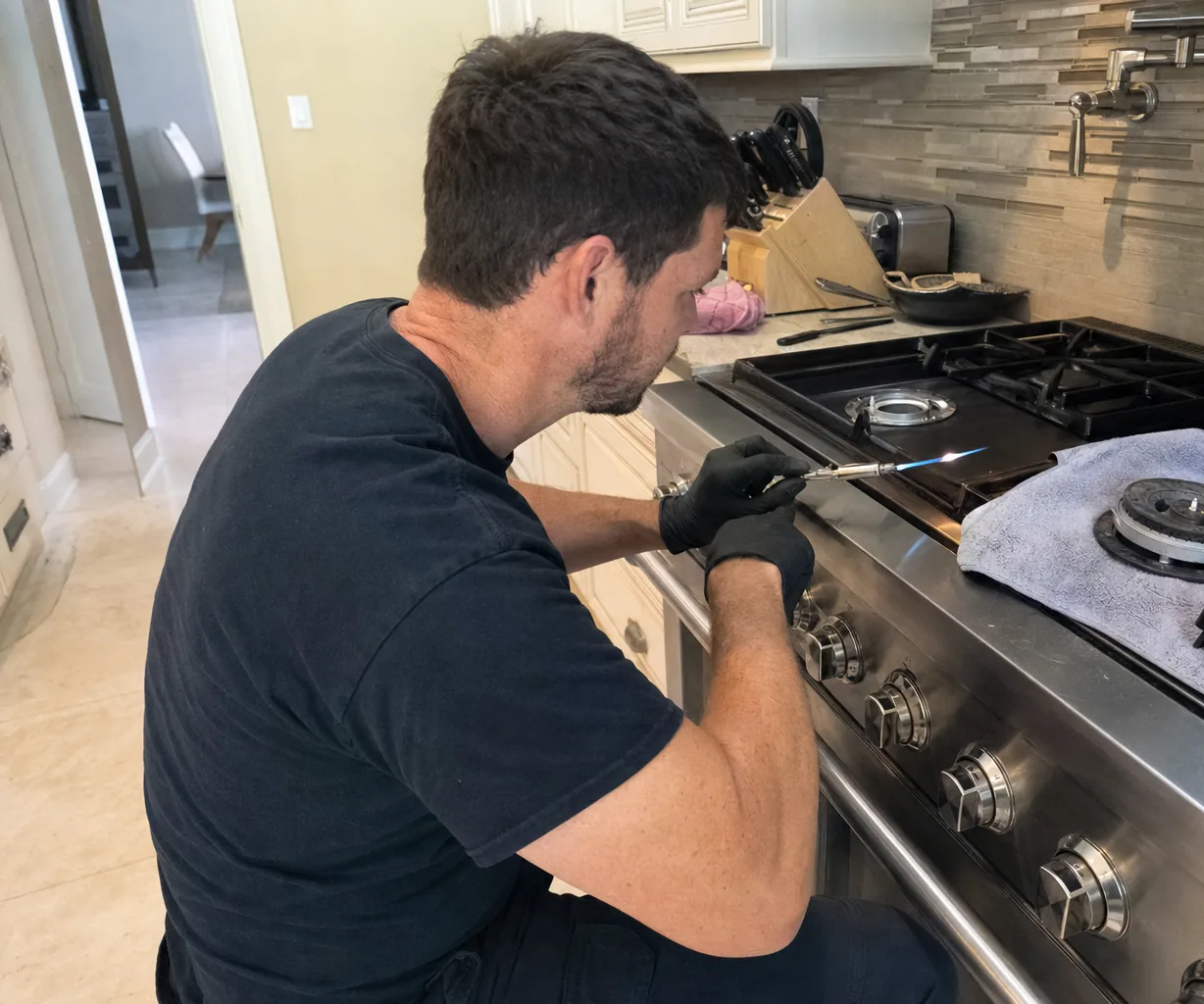
Wolf dual-fuel range repair
A dual-fuel range is a gas cooktop sitting on top of an electric oven. The two halves share a control board and almost nothing else, so a burner problem and an oven problem on the same range are usually unrelated.
What we get called for
-
The igniter keeps clicking after the burner has lit
Usually a wet or misaligned igniter electrode, or a burner cap that is not seated square on its base. The spark module cannot sense a flame it cannot see, so it keeps firing.
-
Every igniter fires at once when one burner is turned on
That is normal behaviour for a single spark module driving all the electrodes. It becomes a fault only when the clicking does not stop once the flame is established.
-
The oven runs cool or drifts away from the set point
Temperature drift usually traces back to the oven sensor, a tired door gasket, or a hinge that has sagged far enough to hold the door a couple of millimetres open along the top edge.
-
One burner burns with a lazy, uneven or yellow-tipped flame
A partially blocked port ring. Boil-over dries into the ports and the flame goes ragged on one side of the cap while the rest of the ring looks normal.
-
The oven has gone completely dead but the burners still light
The two halves of a dual-fuel range are separate systems. A dead oven with working burners points at the oven relay board, an element circuit or the 240-volt supply, not at anything on the cooktop.
-
The convection fan rattles or howls when the oven is hot
Usually the fan bearing or a loose baffle behind the rear panel. It gets louder as the oven comes up to temperature because the shaft and the housing expand at different rates.
Two appliances that happen to share a cabinet
A dual-fuel range is two appliances bolted into one shell. The cooktop burns gas, the oven heats electrically, and beyond a shared fascia, knobs and control board they have almost nothing in common: different fuel, different safety circuits, different failure modes.
That matters on the phone. A cold oven and a burner that will not light get described as one problem with the range; they are almost always two that became noticeable in the same week, and we diagnose them separately. A quote for one is not a quote for the other, and we say so before we drive out.
The gas half
Sealed burners are mechanically simple and fail in a small number of predictable ways. The most common call is an igniter still clicking after the flame is burning. Almost always the electrode is wet, or the cap sits a hair off square on its base so the flame is not where the module expects it. Dry the electrode, set the cap down flat, and the clicking usually stops. If it does not, the ceramic may be cracked, letting the spark leak to ground instead of jumping the gap.
Second most common is a flame gone lazy on one side: a blocked port, not a gas-supply problem. Something boiled over, dried in the ports, and part of the ring is starved. It cleans up.
The third is every electrode firing at once when you turn one knob. That is the design — one module, all the electrodes in parallel — and it is a fault only when the clicking will not stop.
The electric half
The oven side is where the interesting failures live, and temperature drift is the one we see most. Owners notice it in baking rather than roasting: cakes sink, bread crusts early, and the roast comes out fine because a roast forgives. Drift traces to the oven temperature sensor, a hardened door gasket, or a hinge sagged far enough to hold the door two millimetres open at the top. You cannot see two millimetres. The oven can.
Control boards are the other big one. This area sees roughly 68 thunderstorm days a year, and a board that has taken a surge rarely dies cleanly: an element that heats sometimes, a fan that runs when it should not, a display that reads correctly while the oven does something else. We check the supply and the board before condemning anything expensive.
What the coast does to a range
In the beach ZIPs — Ponte Vedra Beach, Neptune Beach, Atlantic Beach, Jacksonville Beach and the older streets of St. Augustine — salt air gets into everything unsealed. Hinge pins stiffen, bind, then pull the door out of alignment. Back-panel fasteners seize. Stainless that is never wiped pits along the door edge. None of it is dramatic in any given week, and all of it arrives as an alignment or seal problem two or three years earlier than it would ten miles inland.
How we work on these
We are an independent shop, so the first thing we do is tell you what is actually wrong rather than what a parts list says should be replaced. We fit genuine OEM parts, and the figures above are what these repairs come to.
What it costs
What does a dual-fuel range repair usually cost?
Every call starts at the same flat $80 diagnostic, credited toward the work once you approve it. The bands below cover part and labor together.
| What gets put right | Typical range |
|---|---|
| Diagnostic visit | $80 flat |
| Igniter or spark module replacement | $210–$500 |
| Oven thermostat or temperature sensor | $190–$520 |
| Convection fan or motor | $260–$660 |
| Burner valve or orifice service | $220–$690 |
Straight answers
Questions we get asked about this
- The gas top works but the electric oven is dead. Is the whole range finished?
- Almost never. A dual-fuel range is two largely separate machines sharing one cabinet, and the oven has its own control, element circuit and door latch. A dead oven beside live burners points at the oven side alone, and that is usually one component rather than the whole appliance.
- Why does the oven drift away from the temperature I set?
- The oven sensor is a resistance probe, and as it ages its readings wander. The control obeys what it is told, so a drifted probe gives you an oven that is confidently wrong. We measure against our own thermometer over two full cycles before choosing between calibration and a new probe.
What this part of Florida does to it
Three local conditions shorten the life of cooking equipment here. These are the ones that matter for this appliance.
- Older kitchens
- A great deal of the housing here predates the equipment now installed in it — the 1900s–1930s streets of Riverside, Avondale and Old Ortega, the 1960s and 1970s houses along Mandarin Road and around Orange Park. Cabinet openings widened by hand leave uneven clearances, dedicated circuits are frequently missing, and anything plumbed or ducted has to follow a route nobody planned for it.
- Salt air
- In the coastal ZIPs — 32082, 32250, 32266, 32233 and 32084 — salt air corrodes hinge pins, exposed fasteners and outdoor ventilation hardware years earlier than it would inland.
- Storm season
- This area sees roughly 68 thunderstorm days a year. Control boards fail after surges, and they fail in ways that look like an unrelated mechanical fault.
Keep reading
Book a diagnostic visit
An $80 flat diagnostic fee covers the visit and the diagnosis, and it is credited toward the repair if you go ahead with the work. You get a written estimate before anything is replaced.
Owner feedback
Owners we did this for
4.9 out of 5 from 95 customer reviews. Each one below is a single visit. Read all 95.
Preheat had crept out to the best part of forty minutes. He found the door seal flattened along the bottom edge and a convection baffle missing since an earlier repair. Both replaced and preheat is normal again.
Anselma K.2026-09-09
The clock reset itself every time the oven called for heat. He found the neutral loose at the junction box behind the range, remade it properly, and stayed to watch a full bake cycle before packing up.
Bettina L.2026-08-29
The convection element glowed but the fan stayed still, so everything browned on one side only. He found the motor windings open, fitted a new motor and balanced the blade so it runs quiet at every speed.
Gideon W.2026-08-05