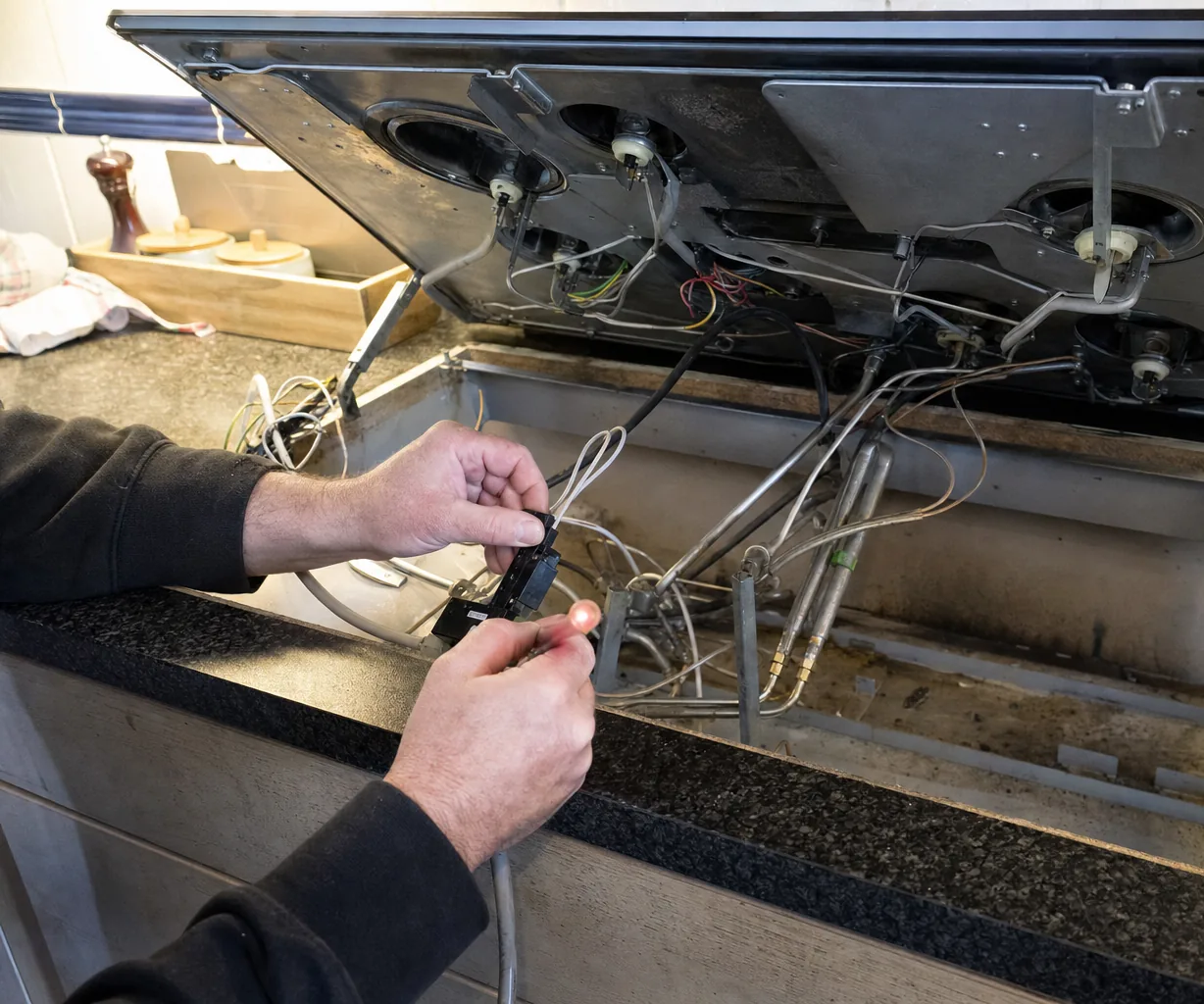
What the clicking actually is
When you turn a burner knob to the light position, a spark module sends a high voltage pulse to an electrode sitting beside the burner. The spark jumps a small gap, gas ignites, and the module then has to decide whether it worked. On most sealed-burner cooktops that decision is made by sensing the flame through the same electrode: a flame conducts, so the module sees current and stops sparking.
That is the whole mechanism, and it is why the failure is so specific. The clicking does not mean the burner failed to light. It means the module cannot see the flame that is burning right in front of it.
The two-minute fix that works most of the time
The single most common cause is water. Something boiled over, or the cooktop was wiped down and liquid ran into the burner well, and now there is moisture on or around the electrode. To the sensing circuit, a wet electrode looks exactly like no flame at all.
Turn the burner off and let everything cool. Lift the burner cap off. Dry the electrode, the well it sits in and the underside of the cap thoroughly with a paper towel. Then set the cap back down flat.
That last part matters more than people expect. The cap has to sit square on its base so the flame comes up in a ring where the electrode can see it. A cap that is tilted, or resting on a crumb, or dropped into the wrong position after a deep clean, puts the flame slightly off from where the sensing circuit expects it and produces exactly the same endless clicking.
Burner caps are not usually interchangeable between positions, by the way. If your cooktop had a thorough clean recently and one burner has misbehaved ever since, check that the caps went back in the right places.
When it is not water
If the burner is dry, the cap is square and it still clicks, the list gets shorter and more technical.
The electrode ceramic may be cracked. The white insulator around the electrode keeps the spark going to the burner rather than to the nearest piece of metal. Once it is cracked, the spark takes the easy path to ground, and the flame sensing goes with it. You will often see the spark happening in the wrong place if you watch in a dark kitchen.
The electrode may be out of position. It needs to sit at a specific distance from the burner. Knocked in cleaning, or bent by a pan being dragged across the top, it either sparks weakly or sits too far from the flame to sense it.
Or the burner is partly blocked. A ring with dried boil-over in the ports burns unevenly, and if the dead section happens to be the part nearest the electrode, the module is looking at a gap where the flame should be.
Occasionally it is the spark module itself, but that is far down the list, and a module that is genuinely failing usually misbehaves on more than one burner.
Why every igniter fires at once
This one is not a fault and it worries people constantly. A single spark module drives all the electrodes on the cooktop, wired in parallel, so turning on one burner fires every electrode on the appliance. That is how it was designed. It looks alarming and it is entirely normal.
The rule is simple: all of them clicking briefly while one burner lights is correct. Any of them clicking after a flame is established is not.
When to call
If drying and reseating did not fix it, or if the clicking is constant even with all the knobs off — which usually points at a knob or switch not fully returning, or a genuinely failed module — it is a service call. Constant sparking with the burners off should not be left.
We are an independent repair company and we do not charge you for a part you did not need. If the answer turns out to be a wet electrode, we will tell you so and charge you for the visit. A visit is an $80 flat diagnostic, credited toward the repair, with a written estimate before anything is ordered.
Common follow-ups
It clicks but it will not light at all. Is that the same fault?
It is the same family and a different member of it. Clicking with no flame means the spark is arriving and the gas is not meeting it: a cap seated crooked so the spark fires away from the port ring, an electrode wet or cracked, a port ring blocked by a boil-over, or no gas reaching the burner. The two-minute check is the same one — dry the electrode, lift the cap, set it square on its own base — and if the burner still will not catch, stop there and call rather than keep sparking into unburnt gas.
Is it safe to keep cooking while the igniter clicks?
The spark is low energy and the burner is already lit, so it is not dangerous in itself, but the clicking means the module is not sensing the flame and it will keep firing the electrode. Get it looked at rather than living with it.
Why do all the burners click when I only turn on one?
One spark module drives every electrode in parallel, so they all fire together by design. That is normal. It only indicates a fault when the clicking continues after a flame is established.
Can I clean the electrode myself?
Yes. With the burner off and cool, lift the cap, dry the electrode and the well underneath with a paper towel, and set the cap back down flat on its base. Do not scrape the ceramic or bend the electrode.