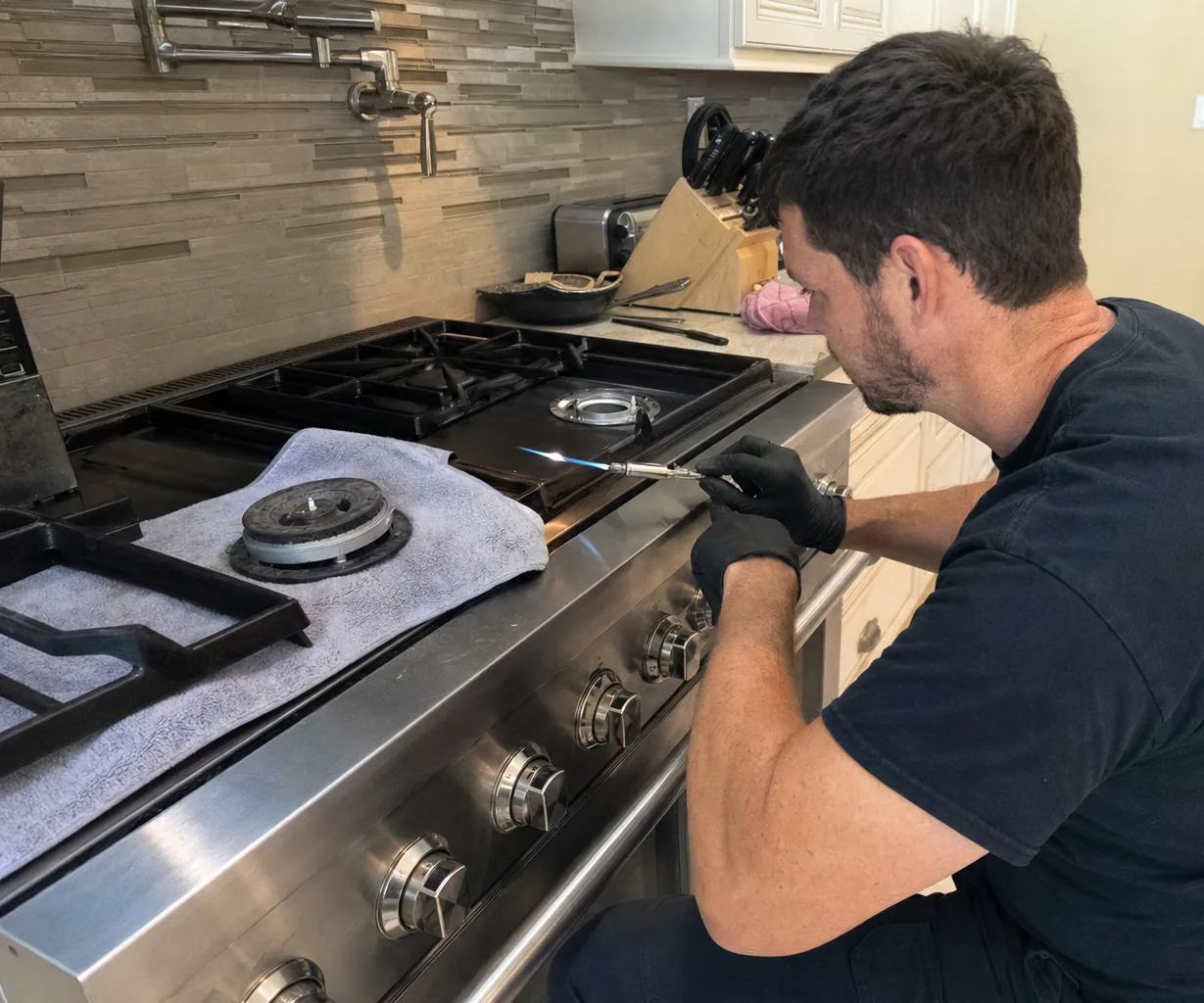
Two appliances that share a fascia
A dual-fuel range is a gas cooktop sitting on top of an electric oven. That is the whole idea, and it exists because the two halves of a range want different things. Gas gives you instant, visible, infinitely variable control at the cooking surface, which is what anyone who cooks by eye wants under a pan. Electric gives you steadier, drier, more even heat in a closed cavity, which is what baking wants.
So the manufacturer put both in one cabinet. Underneath the shared fascia and the shared row of knobs, though, they are genuinely separate systems: separate fuel, separate safety circuits, separate parts, separate failure modes.
Why that matters when you call
The most common conversation we have about these goes something like: the oven has gone cold and the front-left burner will not light. It gets described as one problem with the range.
It is almost always two problems. They became noticeable in the same week because the range gets used every day and people notice things in batches, not because one caused the other.
That has two practical consequences and we say both on the phone. An estimate for one half is not an estimate for the other. And diagnosing one does not diagnose the other, so if you have symptoms on both halves, tell us both when you book rather than after we arrive — it changes what we bring.
What the gas half does when it fails
Sealed burners are mechanically simple and fail in a short list of ways. An igniter that keeps clicking after the flame is up, which is nearly always a wet electrode or a burner cap sitting off square. A flame that has gone lazy on one side of the ring, which is a blocked port rather than a supply problem. A burner that will not hold a low simmer while its high flame looks perfect, which is the same blockage seen from the other end — the simmer runs through a much smaller path, so it notices restriction the high flame shrugs off.
None of those have anything at all to do with the oven.
What the electric half does when it fails
Oven faults are quieter and slower. Temperature drift is the big one: the sensor’s resistance curve moves as it ages, the oven comes up short, and the error grows with temperature. Twenty-five degrees low at 350 might be sixty low at 500. Bakers find this months before roasters do.
Then there are elements that have failed open, relay boards that no longer switch cleanly, convection fans with worn bearings that howl once everything is hot, and door seals and hinges that let heat out along the top edge.
Again, none of those have anything to do with the burners.
The one thing they share
The exception is the control board. Both halves report to it, and that is why a board problem is the one fault that can genuinely produce symptoms on the cooktop and in the oven at the same time.
It is also why storms matter here. This area sees roughly 68 thunderstorm days a year, and surge damage to a range control rarely announces itself as electrical. It shows up as an oven that heats intermittently, a mode that stopped working while everything else is fine, or a display that reads correctly while the appliance does something different. If the two halves of your range have gone strange in the same week and there has been weather, the board is where we look first.
And the supply
The other shared dependency is power. A dual-fuel range needs a dedicated 240-volt circuit for the oven side. In older kitchens — the 1900s to 1930s houses in Riverside, Avondale and Old Ortega especially — that circuit was often added during a remodel, and how well it was added varies. A marginal supply produces intermittent faults that look convincingly like a failing board.
We are an independent shop, and on a range with symptoms at both ends we check the supply and the board before condemning anything on either half.
Common follow-ups
If the oven is dead, could the burners be next?
Usually not. The gas cooktop and the electric oven are separate systems with separate supplies and separate failure modes. The main thing they share is the control board, so a board fault is the one failure that can affect both.
Why do I need a 240-volt circuit for a dual-fuel range?
The oven half is electric and draws far more current than a spark module and a light. Dual-fuel ranges are wired to a dedicated 240-volt circuit, which is one of the things that catches people out when a professional range goes into an older kitchen.
Is dual-fuel harder to repair than all-gas?
Not harder, just different. All-gas ovens have an ignition circuit and a gas safety valve that dual-fuel ovens do not. Dual-fuel ovens have elements, relays and a heavier electrical supply instead.