The complaint is almost never about temperature
Nobody calls to say their oven is 30 degrees low. They call to say that something they have baked for years has stopped working. The bread crusts before the crumb sets. The cake sinks in the middle. The custard weeps. The cook adjusts the recipe, then adjusts it again, and eight months later something finally goes wrong badly enough at a holiday to prompt a phone call.
By the time an oven is obviously broken, it has generally been wrong for a long time.
Why baking is the early warning
A roast is cooked to an internal temperature over a long period. If the oven is 25 degrees cool, the roast takes longer and comes out much the same. The error is absorbed by time.
Baking does not work that way. A cake is a sequence of events that has to happen in the right order: the batter has to set at roughly the same moment the leavening finishes doing its work, the crust has to form after the rise rather than before it. Shift the temperature and the sequence reorders. The crust sets early and traps a rise that then collapses. That is why the same oven produces an acceptable roast and an unacceptable cake, and why bakers are almost always the ones who call us.
Where the error comes from
There are three usual sources and they feel identical from the outside.
The temperature sensor. It is a resistance probe, and the control reads temperature by reading its resistance. As the probe ages, its curve moves. An oven whose sensor reads high will always come up short of the set point, and crucially, the error usually grows with temperature — 25 degrees low at 350 can be 60 low at 500. That is why the problem shows up at bread temperatures before it shows up anywhere else.
The door seal. Gaskets harden, take a set, and stop sealing at the corners. Heat leaking out means the oven cycles more often trying to keep up. Preheats get long and the cavity never settles.
The hinges. This is the one nobody guesses. Oven doors are heavy and their whole weight passes through two small pivots. Once those wear, the door drops and stands a couple of millimetres open along the top edge. Two millimetres is invisible to you and enormous to the oven.
What we actually do about it
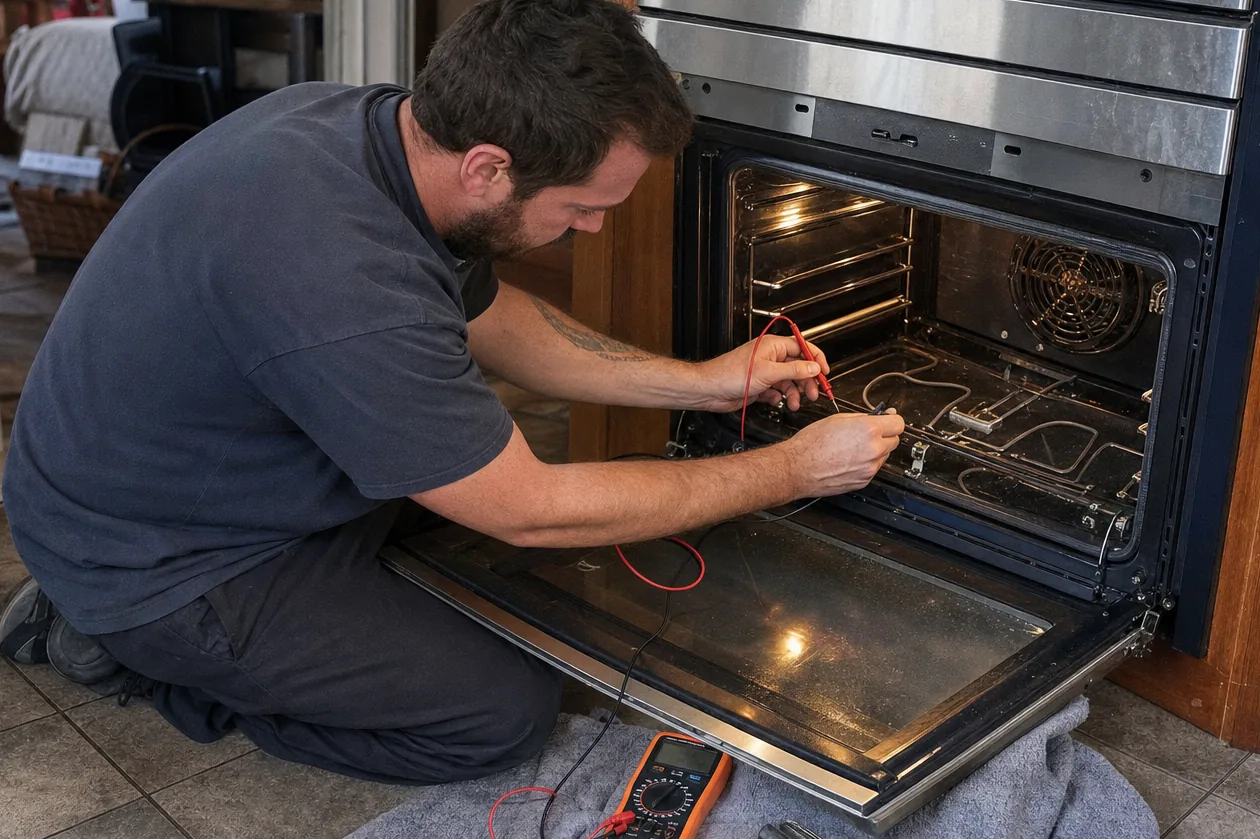
We measure. A calibrated probe goes into the cavity and we log a full heat-and-hold cycle against the set point, because the display on the front tells you what the oven intends and nothing about what it achieves.
Three numbers come out of that: the offset, whether the offset grows with temperature, and the size of the swing during a hold. A flat offset that does not change with temperature is often a calibration adjustment. An offset that widens as the oven gets hotter points at the sensor. A wide, slow swing during a hold points at heat escaping — the door, the gasket or the hinges.
That distinction is the whole job. Recalibrating an oven that is actually leaking heat hides the problem for a few weeks and then it comes back worse.
The local factor
Roughly 68 thunderstorm days a year pass over this part of Florida, and control boards do not enjoy them. A surge-damaged control often does not fail outright — it produces erratic cycling that reads as a temperature problem. When an oven has gone from accurate to strange rather than accurate to consistently cool, and there has been weather, the board is part of the diagnosis.
Along the coast, in Ponte Vedra Beach, Neptune Beach and St. Augustine, salt air stiffens hinge pins, which brings the sag problem forward by years and makes the door a likelier culprit than it would be inland.
We are an independent repair company. We will tell you when the fix is an adjustment rather than a part, and the visit is an $80 flat diagnostic credited toward the repair.
Common follow-ups
Can I check my oven with a supermarket oven thermometer?
It will tell you roughly whether you have a problem, which is useful. It will not tell you the shape of the problem, because a dial thermometer responds slowly and only reads one spot. We log actual cavity temperature through a full heat-and-hold cycle instead.
My oven is 25 degrees low. Can it just be recalibrated?
Sometimes. Many ovens have an offset adjustment that will absorb a small, consistent error. It is the wrong answer when the error grows with temperature or swings during a hold, because that points at a failing sensor or a leaking door rather than calibration.
Why does my roast come out fine when my cakes do not?
A roast is forgiving. It cooks by internal temperature over a long period, so a 25-degree error mostly changes the timing. Baking depends on a chemical sequence happening at specific temperatures in a specific order, and it fails visibly when that sequence shifts.