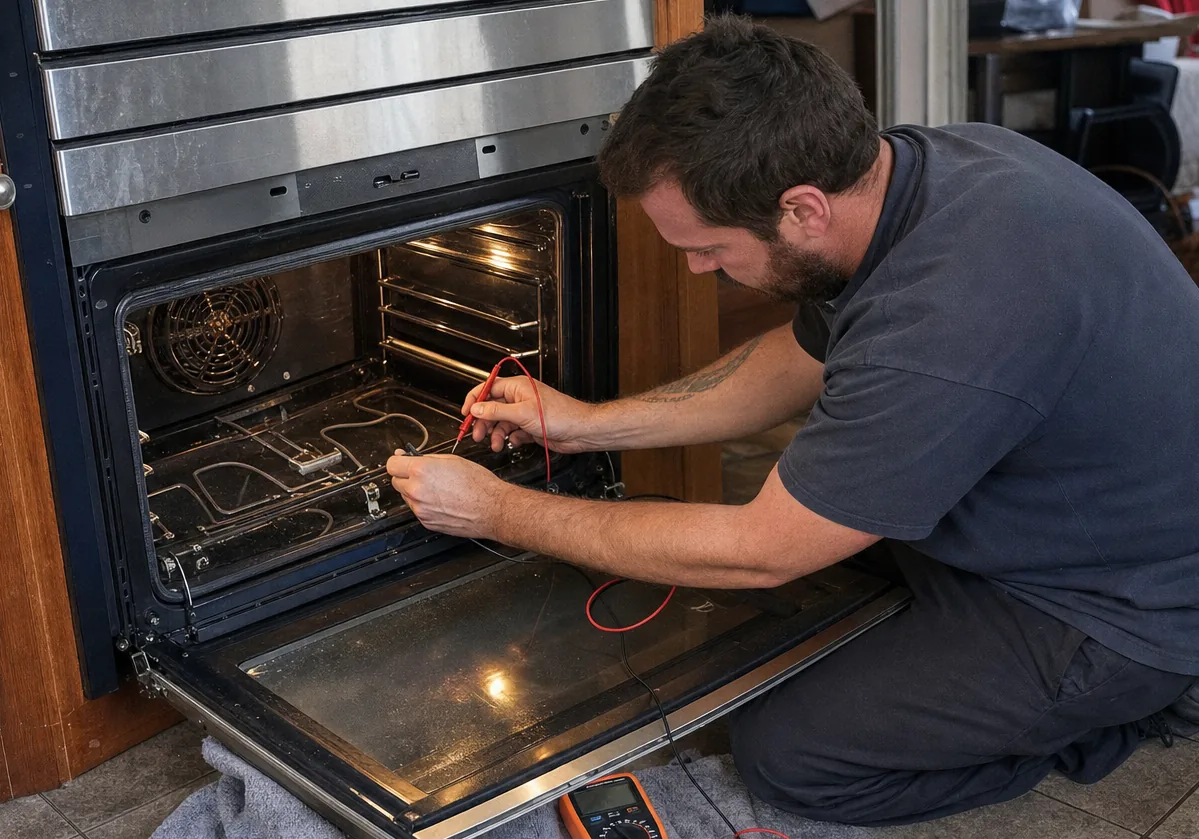
A failure that shows up somewhere else
Almost nobody calls about a hinge. They call about baking, or preheat times, or an oven that seems to have become unreliable in the last year. The door looks fine. It closes. It latches. Nothing rattles.
Then we put a strip of paper in the top corner, close the door and pull, and the paper comes out without resistance. Do the same at the bottom and it grips hard. That is hinge sag, and it is one of the most common genuine faults on a built-in oven that is more than about eight years old.
Why it happens
A built-in oven door is heavy. Two panes of glass or more, a layer of insulation, a steel skin, a handle. All of that weight is carried by two hinges, and each hinge concentrates the load into a small pivot with a spring mechanism that has to balance a door that is heavy at the far end of a lever.
Every time the door opens, that load cycles. Over years the pivots wear, the spring loses some of its balance, and the door begins to hang fractionally low at the outer edge. The bottom of the door still presses on the gasket, because the latch pulls it in there. The top of the door — the part furthest from both the hinge and the latch — stands off.
Two things accelerate it dramatically. One is using the open door as a shelf for a heavy pan, or leaning on it. The other is salt air. In the coastal ZIPs, Ponte Vedra Beach and the Beaches and the older streets of St. Augustine, salt gets into the hinge pivots, they stiffen, and a stiff hinge takes shock loads instead of absorbing them. Doors in coastal kitchens sag years earlier than identical doors ten miles inland.
Why two millimetres is a lot
It seems implausible that a gap you cannot see could matter. Consider what is on either side of it.
Inside, the cavity is at 375 degrees. Outside, the kitchen is at 75. That is a 300-degree difference across a slot that runs the full width of the door, positioned at the top of the cavity, which is exactly where hot air wants to leave. Convection does the rest. Hot air escapes along the top, cooler room air is drawn in low, and the oven never stops fighting a current it cannot close off.
What you see is an oven that overshoots, recovers, overshoots again, and produces a swing at the food far wider than the display suggests. The average might even be right. The peaks are not, and baking cares about the peaks.
What it is not
It is worth separating hinge sag from the gasket, because they produce similar symptoms and get confused constantly.
A gasket problem is a seal that has hardened, torn or taken a permanent set, and it usually shows up as leakage at a specific spot. Hinge sag is a geometry problem — the door is not in the plane it should be — and replacing a gasket on a sagging door achieves very little, because the new gasket simply gets held away from the frame like the old one was.
We check the geometry first for that reason. A door that is square with a tired gasket is a gasket job. A door that is out of plane is a hinge job, and the gasket may well be fine.
What we do
We check the door alignment across the whole frame, look at hinge condition and free play, and confirm whether the latch is pulling the door in evenly. Then we measure what the cavity is actually doing across a full cycle, because that tells us whether the gap is costing you real temperature stability or whether something else is going on as well.
We are an independent shop and we would rather fix the geometry than sell you a sensor. A visit is an $80 flat diagnostic, credited toward the repair, with a written estimate before anything is ordered.
Common follow-ups
How do I check whether my oven door is sealing?
With the oven cold, close a strip of paper in the door at several points around the frame and pull on it. It should drag noticeably everywhere. If it slides out easily at the top corners but grips at the bottom, the door is hanging open at the top.
Can hinges be adjusted rather than replaced?
Sometimes. Some hinge designs have adjustment, and a door that is out of alignment because of a loose mounting can be reset. A hinge with worn pivots has to be replaced, and hinges are always replaced in pairs so the door hangs evenly.
Does standing on the open oven door really matter?
Yes, and so does resting a heavy roasting pan on it. Oven doors are designed to carry their own weight on two small pivots, not a load applied at the far end of a long lever. That is the fastest way to bend a hinge or the door frame.