What we fix
Wolf wall oven and built-in oven repair
Wall ovens fail quietly. The temperature drifts, the door stops sealing along the top, the convection fan starts to sing, and none of it is obvious until baking goes wrong. Most of it is measurable in the first twenty minutes of a visit.
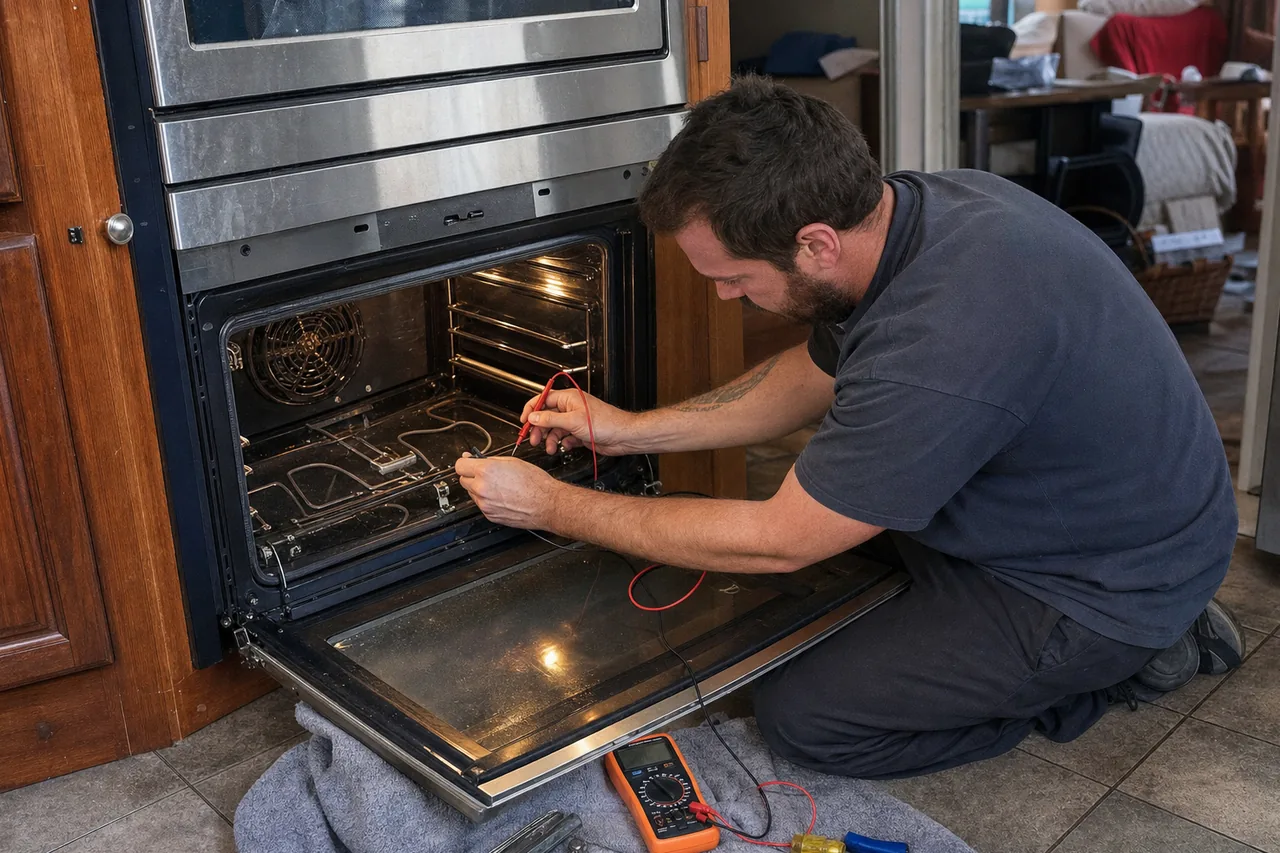
What we get called for
-
Baking has gone wrong but roasting still seems fine
The signature of temperature drift. Roasts tolerate a 25-degree error and cakes, custards and bread do not, so baking always shows the problem first.
-
The oven takes far longer to preheat than it used to
Either an element that is no longer drawing full current, a sensor reading high so the oven thinks it is closer to temperature than it is, or heat escaping past a door that no longer seals.
-
The door does not sit flush and the top corner shows a gap
Hinge sag. Heavy oven doors put a constant load on the hinge pivots, and once they wear the door hangs a few millimetres open along the top edge where you cannot see it.
-
The door stayed locked after a self-clean cycle
The door lock motor or its switch. Self-clean puts the latch mechanism through the hottest hour it ever sees, and a marginal latch fails at the end of that cycle rather than during it.
-
The convection fan rattles, whines or grinds when hot
A worn fan bearing or a fan blade contacting its baffle once everything has expanded. It is often silent cold and loud at 400 degrees, which is a useful clue.
-
The oven behaves strangely after a storm
Surge damage to the control or relay board. It presents as intermittent heating, a display that does not match what the oven is doing, or a mode that no longer works while others do.
-
The interior light stays on or will not come on at all
Usually the lamp or the door switch. A door switch that reads the door as open can also stop convection or the broiler from running, so it is worth checking early.
Ovens fail slowly, and that is the problem
Nothing about a failing wall oven announces itself: no leak, no noise, no smell. A cook who has made the same loaf for six years starts getting a pale crust and a dense crumb, blames themselves, adjusts the recipe, and calls somebody eight months later when the Thanksgiving pie will not set. By the time an oven is obviously broken it has been wrong for a long while.
So the first thing we do is measure: a calibrated probe in the cavity, watched through a full heat-and-hold cycle against the set point. The display on the front tells you what the oven intends to do and nothing about what it is doing.
Where drift comes from
There are three usual sources, and they feel identical to the cook.
The temperature sensor is the first. It is a resistance probe, and as it ages its curve moves. An oven whose sensor reads high always comes up short, and worse at the top of the range than the bottom — 25 degrees off at 350 can be 60 off at 500, which is why it shows at bread temperatures before roasting temperatures.
The door gasket is the second. Gaskets harden, take a set and stop sealing at the corners. Heat escaping past a gasket makes the oven cycle more often to compensate, which shows up as long preheats and an oven that never quite settles.
The third is the hinges, and it is the one people never guess.
Heavy doors and tired hinges
A built-in oven door is heavy — glass, insulation, a steel skin — and every time it swings, the whole weight passes through two small pivots. Over years those pivots wear, the door drops slightly at the outer edge, and the top of the door is left standing a couple of millimetres off the seal.
You cannot see two millimetres across a door edge. But an oven trying to hold 375 degrees against a two-millimetre slot along its top edge is fighting a constant leak, and it never wins cleanly. It overshoots, it recovers, it overshoots again, and the temperature swing at the food is far wider than the number on the display suggests.
French-door and side-swing doors carry their weight differently but they sag in the same way. Hinges can usually be adjusted or replaced; what cannot be fixed is a door that has been used as a shelf for a heavy roasting pan often enough to bend the frame.
Boards, storms and the surge that looks mechanical
Roughly 68 thunderstorm days a year go over this part of Florida, and control boards do not enjoy them. The important thing to know is that a surge-damaged oven almost never looks electrical. It looks like a bad element, or a broken fan, or a mode that stopped working while everything else carried on. We check the incoming supply and the board before condemning anything else, because replacing an element into a damaged board is money spent twice.
Coastal kitchens add a second factor. In Ponte Vedra Beach, Neptune Beach and the older parts of St. Augustine, salt air stiffens hinge pins and seizes the fasteners around the door frame, which brings the sag problem forward by years.
Booking a visit
We are an owner-operated shop with no parts quota and no network scorecard, which is why we can tell you when an oven is worth repairing and when it is not. Genuine OEM parts, and the figures above before anything is ordered.
What it costs
What does a built-in and wall oven repair usually cost?
Every call starts at the same flat $80 diagnostic, credited toward the work once you approve it. The bands below cover part and labor together.
| What gets put right | Typical range |
|---|---|
| Diagnostic visit | $80 flat |
| Oven thermostat or temperature sensor | $190–$520 |
| Convection fan or motor | $260–$660 |
| Door hinge, glass or seal | $200–$690 |
| Control board or touch panel | $440–$1,050 |
Straight answers
Questions we get asked about this
- Why has baking gone wrong while roasting still seems fine?
- Roasting forgives a swing of several degrees and baking does not, so a drifting sensor or a tired bake element shows up in bread and pastry long before it shows up in a roast. It is the most useful symptom you can describe on the telephone, because it narrows the diagnosis immediately.
- The door stayed locked after a self-clean cycle. What happens now?
- The latch motor drives a hook that has to travel back once the cavity cools, and a stripped gear or a failed switch leaves it holding. There is usually a reset worth trying first, and we will talk you through that by telephone before anybody gets into a van.
What this part of Florida does to it
Three local conditions shorten the life of cooking equipment here. These are the ones that matter for this appliance.
- Salt air
- In the coastal ZIPs — 32082, 32250, 32266, 32233 and 32084 — salt air corrodes hinge pins, exposed fasteners and outdoor ventilation hardware years earlier than it would inland.
- Storm season
- This area sees roughly 68 thunderstorm days a year. Control boards fail after surges, and they fail in ways that look like an unrelated mechanical fault.
Keep reading
Book a diagnostic visit
An $80 flat diagnostic fee covers the visit and the diagnosis, and it is credited toward the repair if you go ahead with the work. You get a written estimate before anything is replaced.
Owner feedback
Owners we did this for
4.9 out of 5 from 95 customer reviews. Each one below is a single visit. Read all 95.
The rack glides had seized and the shelves fought me every time. He took the racks out, cleaned and lubricated the runners, and replaced one side rail that had twisted out of true.
Isolde F.2026-09-02
Temperature was swinging forty degrees either side of the setting. The sensor probe had drifted badly out. He fitted a new probe, verified it against his own gauge, and left the oven holding within a few degrees.
Konstantin E.2026-07-29
Both doors on the double oven had dropped at the front. He replaced four tired hinge springs, then reset the doors square so the seals meet along their whole length. The upper cavity holds heat properly now.
Thaddeus G.2026-08-16