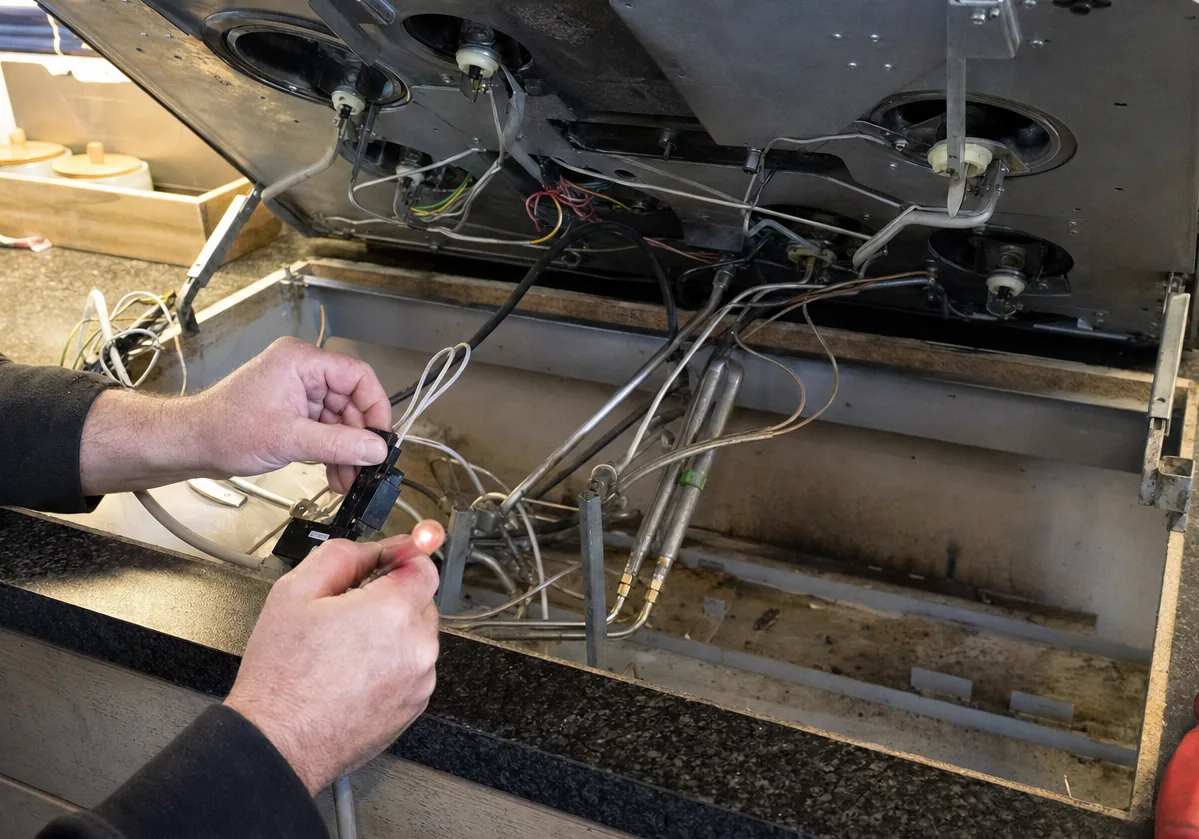
Sixty-eight days a year of opportunity
This part of Florida sees roughly 68 thunderstorm days in an average year. That is a great deal of electrical weather, and appliance control boards are where it gets paid for. Not every storm damages something, and most surges that reach a house are far smaller than the dramatic ones people imagine. The cumulative effect over a decade is the real issue.
What makes this worth writing about is not that boards fail. It is how they fail, because the way they fail sends people down the wrong diagnostic path almost every time.
Surge damage does not look electrical
If a control board simply died, everything would be easy. The appliance would be dark and the diagnosis would take five minutes.
What actually happens is more subtle. A transient degrades one part of a board — a relay contact that no longer closes reliably, a driver that switches sometimes, a track or a solder joint that has been stressed. The rest of the board carries on working perfectly. So what you get is:
An oven that heats sometimes. It preheats fine on Monday and never gets past 200 on Thursday. That reads as a failing element.
A convection mode that has quietly stopped working while bake and broil are fine. That reads as a failed fan.
A display that shows the right numbers while the appliance does something else. That reads as a temperature sensor problem.
An induction element that runs normally for twenty minutes and then quits. That reads as thermal cutback from blocked ventilation.
Every one of those is a plausible mechanical or thermal diagnosis. Every one of them can also be a partly damaged board, and if you replace the element, the fan or the sensor without checking, you will have bought a part and kept the fault.
How we tell the difference
The order matters. We check the incoming supply first — voltage, and whether both legs of a 240-volt circuit are healthy, because a lost leg produces symptoms that look exactly like half the appliance failing. Then we check what the board is actually commanding versus what the load is doing. If the board is calling for heat and the element is not drawing current, that is an element or a connection. If the board is not calling for heat at all when it should be, no new element will help.
That sequence is not clever, it is just discipline, and it is the difference between one visit and three.
Timing is a clue, not proof
If the appliance changed behaviour in the same week as significant weather, that is worth telling us when you book. It moves the board up the list.
It is not conclusive in either direction, though. Damage can present weeks later, because a degraded component can hold up under light load and fail when it is next asked to work hard. And plenty of boards fail from ordinary age and heat with no storm involved at all — particularly boards that live behind the fascia of an appliance squeezed into a tight cabinet opening with poor airflow around it, which is a common situation in remodelled older kitchens.
What you can do about it
A whole-home surge protective device at the panel is genuinely worth having here, and it is inexpensive relative to a set of built-in appliance boards. It handles the large transients arriving on the service entrance, which is the most common path.
Beyond that: give the appliances air. Heat is the other thing that ages electronics, and an appliance that has been forced into an opening that is a little too tight runs hot behind the panel for its whole life.
We are an independent repair company. We check the supply and the board before condemning anything expensive, and the visit is an $80 flat diagnostic credited toward the repair, with a written estimate before anything is ordered.
Common follow-ups
Will a whole-home surge protector prevent this?
It helps considerably, particularly for the large transients that come in on the service entrance, and it is worth having in this part of Florida. It is not absolute, because some damage arrives on other paths and some is cumulative rather than from a single event.
My oven worked fine right after the storm and failed two weeks later. Is that related?
It can be. A transient can degrade a component without destroying it, and the failure follows later under normal load. That delay is one of the reasons surge damage gets misdiagnosed as an unrelated fault.
Is it worth replacing a board on an older appliance?
Sometimes yes and sometimes no, and we will tell you which. On a built-in appliance that is otherwise sound and expensive to replace, a board is usually worth it. On one with several other tired components, we will say so before you spend the money.