What we fix
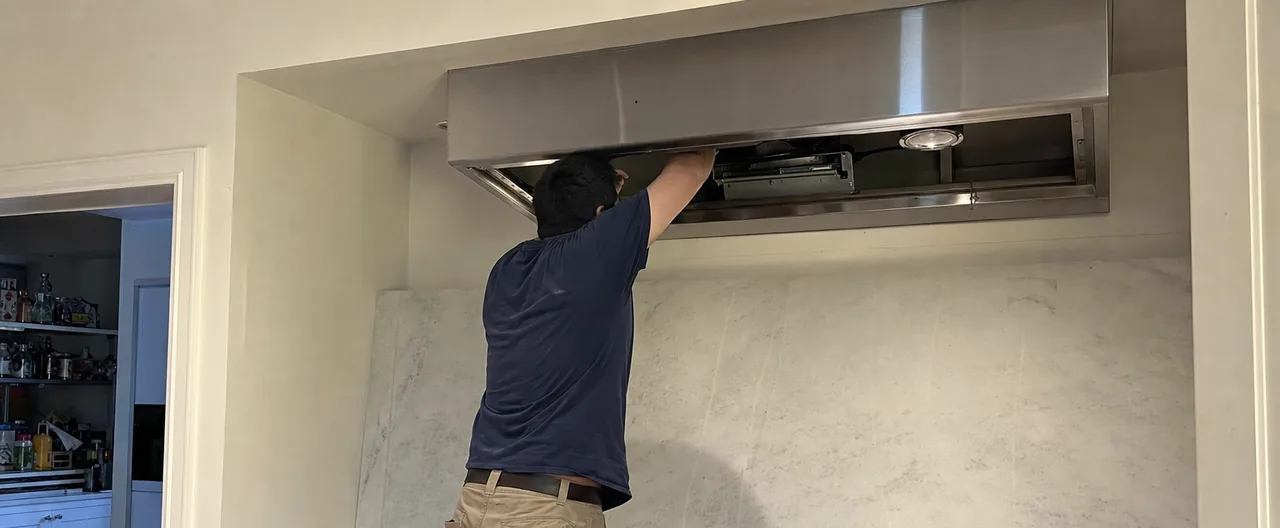
Wolf ventilation and range hood repair
A professional hood is a blower, a duct, a set of baffles and a damper, and every one of those can be the reason a kitchen still smells of last night's fish. Coastal air and grease do most of the damage here.
What we get called for
-
The hood is loud but the kitchen still fills with smoke
Noise without extraction almost always means the air is not getting out: grease-loaded baffles, a crushed or over-elbowed duct run, or a backdraft damper that is no longer opening fully.
-
The blower has developed a rumble, whine or vibration
Bearing wear, or grease build-up on one side of the blower wheel putting it out of balance. An unbalanced wheel gets progressively louder and eventually takes the motor with it.
-
The hood works but the doors slam when it is on high
The kitchen is short of makeup air. A high-output hood can pull the whole house negative, and the residential code requires makeup air for exhaust systems over 400 CFM for exactly that reason.
-
Outside air, insects or cooking smells come back down the duct
A backdraft damper stuck open, corroded, or fouled with grease. On the coast the roof or wall cap is usually the first thing salt air takes.
-
The hood lights flicker, fail early or will not switch
Heat and vibration are hard on lamps and their holders, and the switching side of a hood control lives directly in a stream of warm greasy air.
-
The controls respond intermittently or a speed has stopped working
Usually the control board or the speed switching. Grease vapour migrates into the control housing over years and it does not do connections any favours.
-
An external or in-line blower has become much louder
These are mounted in an attic, on a roof or on an outside wall, and they are exposed. Bearing wear plus corrosion in a coastal ZIP is the usual combination.
Noise is not extraction
The most common thing we hear about a hood is that it is loud and the kitchen still smells. Those two facts belong together more often than not. A blower that is moving very little air is frequently louder than one moving a lot, because what you are hearing is turbulence and restriction rather than airflow.
The paper test settles it in five seconds. Run the hood on high and hold a sheet of paper up against the baffles. If it does not pin itself there, the system is not moving air, and the fault is somewhere between the baffle and the outdoors — not in the motor’s willingness to spin.
Where the restriction usually is
Baffles come first, and they are the owner’s job rather than ours. Baffle filters are designed to be pulled out and run through a dishwasher, and when they are neglected the grease bridges the gaps and the open area collapses. A hood with clogged baffles works hard and achieves nothing.
The duct run comes second, and it is where installation sins show up. Every elbow costs airflow. A long horizontal run costs airflow. Flexible duct where rigid should have been used costs a great deal of airflow. We cannot rebuild a duct run on a service call, but we can tell you honestly when the hood is healthy and the ductwork is the problem, which saves you paying for a blower you did not need.
The damper comes third. A backdraft damper is a set of light flaps that should swing open under airflow and fall closed when the hood stops. Grease gums them shut. Salt corrodes the pivots. A damper that only half opens strangles the whole system, and one that will not close lets outside air, humidity and insects come back down the duct.
The 400 CFM line, and why doors slam
If your hood is a serious one and your house is reasonably tight, there is a question worth asking: where is the air coming from?
A hood only exhausts what it can replace. Pull several hundred cubic feet a minute out of a sealed house and the house goes negative — interior doors suck shut, exterior doors get hard to open, and in the worst case other vented gas equipment in the building can be pulled off its own draught. That last one is a reason to get the hood right, and a matter for whoever services that equipment; our work stops at the kitchen. The residential code recognises the problem and requires makeup air for kitchen exhaust systems rated over 400 CFM.
In practice, in this area, we see it most in the newer construction: Nocatee, Shearwater, SilverLeaf and the newer Jacksonville builds are built tighter than a 1950s Mandarin ranch house, and a big hood in a tight house without makeup air behaves badly. The older Riverside and Avondale kitchens have the opposite problem — they leak enough that makeup air was never an issue, but their duct runs were improvised decades ago.
Salt air eats the outdoor end first
Everything about a hood that lives outdoors is on borrowed time in the coastal ZIPs. Roof and wall caps corrode, damper pivots seize, and external blower housings in Ponte Vedra Beach, at the Beaches and in the older streets of St. Augustine age visibly faster than the same hardware ten miles inland. If a hood in a coastal kitchen has become loud, the odds are good that the noisy part is the one bolted to the outside of the house.
A hood duct is not an HVAC duct
This section exists because the word “duct” on a page like this one keeps being read as central heating, and it is worth being exact about what we touch. A professional hood pulls air off the cooking surface, through baffles, into a duct that runs up or out and terminates in a cap on the roof or the wall. That run carries grease-laden cooking air out of the building. It is kitchen exhaust. It joins nothing. There is no register on it, no return, no coil, no air handler at the other end.
The house’s heating and air conditioning is an entirely separate system with its own ducts, and it is not ours — not the furnace, not the heat pump, not the air handler, not a mini-split, not a thermostat. That is licensed mechanical work and an HVAC contractor is who you want for it.
The one place the two subjects genuinely meet is makeup air. A high-output hood can pull a tight modern house negative enough to slam a door or backdraft an appliance, and residential code requires makeup air above 400 CFM for exactly that reason. We will measure what your hood is actually moving and tell you plainly whether makeup air is your problem. Specifying and installing the system that supplies it is the mechanical contractor’s job, not this shop’s.
What we do
We check airflow, baffle condition, damper operation, blower balance and the control side, and we tell you which of those is your actual problem. We are an independent shop and we are not part of any manufacturer network. The visit is an $80 flat diagnostic, credited toward the repair, with a written estimate before anything is ordered. Genuine OEM parts, 90 days labor, 365 days parts.
What it costs
What does a ventilation hood repair usually cost?
Every call starts at the same flat $80 diagnostic, credited toward the work once you approve it. The bands below cover part and labor together.
| What gets put right | Typical range |
|---|---|
| Diagnostic visit | $80 flat |
| Control board or touch panel | $440–$1,050 |
| Convection fan or motor | $260–$660 |
| Door hinge, glass or seal | $200–$690 |
Straight answers
Questions we get asked about this
- The hood is loud but the kitchen still fills with smoke. Why?
- Noise is the blower working; capture is the duct. A crushed flexible section, an undersized run, or ductwork laid for something much smaller will throttle a good hood to a fraction of its rating. We measure what the hood actually delivers rather than quoting the number on its badge.
- You talk about ductwork — do you work on heating and air conditioning?
- No. A kitchen hood has a duct of its own that carries cooking smoke through a roof or wall cap to the outdoors, and that is the only ductwork we open. Furnaces, heat pumps, mini-splits, air handlers and the ducted system that heats and cools the house are licensed mechanical work and this shop does none of it.
- Why does outside air come back down the hood duct?
- A missing or stuck backdraft damper, or a wall and roof termination that no longer seals. Near the ocean the wind does the rest. It is hood ductwork rather than the hood itself, and it is usually the least expensive part of a ventilation call to put right.
What this part of Florida does to it
Three local conditions shorten the life of cooking equipment here. These are the ones that matter for this appliance.
- Older kitchens
- A great deal of the housing here predates the equipment now installed in it — the 1900s–1930s streets of Riverside, Avondale and Old Ortega, the 1960s and 1970s houses along Mandarin Road and around Orange Park. Cabinet openings widened by hand leave uneven clearances, dedicated circuits are frequently missing, and anything plumbed or ducted has to follow a route nobody planned for it.
- Salt air
- In the coastal ZIPs — 32082, 32250, 32266, 32233 and 32084 — salt air corrodes hinge pins, exposed fasteners and outdoor ventilation hardware years earlier than it would inland.
- Storm season
- This area sees roughly 68 thunderstorm days a year. Control boards fail after surges, and they fail in ways that look like an unrelated mechanical fault.
Keep reading
Book a diagnostic visit
An $80 flat diagnostic fee covers the visit and the diagnosis, and it is credited toward the repair if you go ahead with the work. You get a written estimate before anything is replaced.
Owner feedback
Owners we did this for
4.9 out of 5 from 95 customer reviews. Each one below is a single visit. Read all 95.
Air was coming back down the duct whenever the wind got up off the ocean. He fitted a proper backdraft damper and sealed the transition at the roof. The kitchen no longer smells of dinner at bedtime.
Alaric G.2026-08-02
Filters rattled in their frames and grease was getting past them onto the blower. He fitted the correct baffles, cleaned the housing out, and showed me how they lift out for washing.
Rupert H.2026-07-23
The fan came on by itself in the middle of the night. A stuck touch key on the control was calling for it. He replaced the control panel and the kitchen has been quiet every night since.
Adelheid M.2026-07-14