What we fix
Wolf rangetop, griddle and charbroiler repair
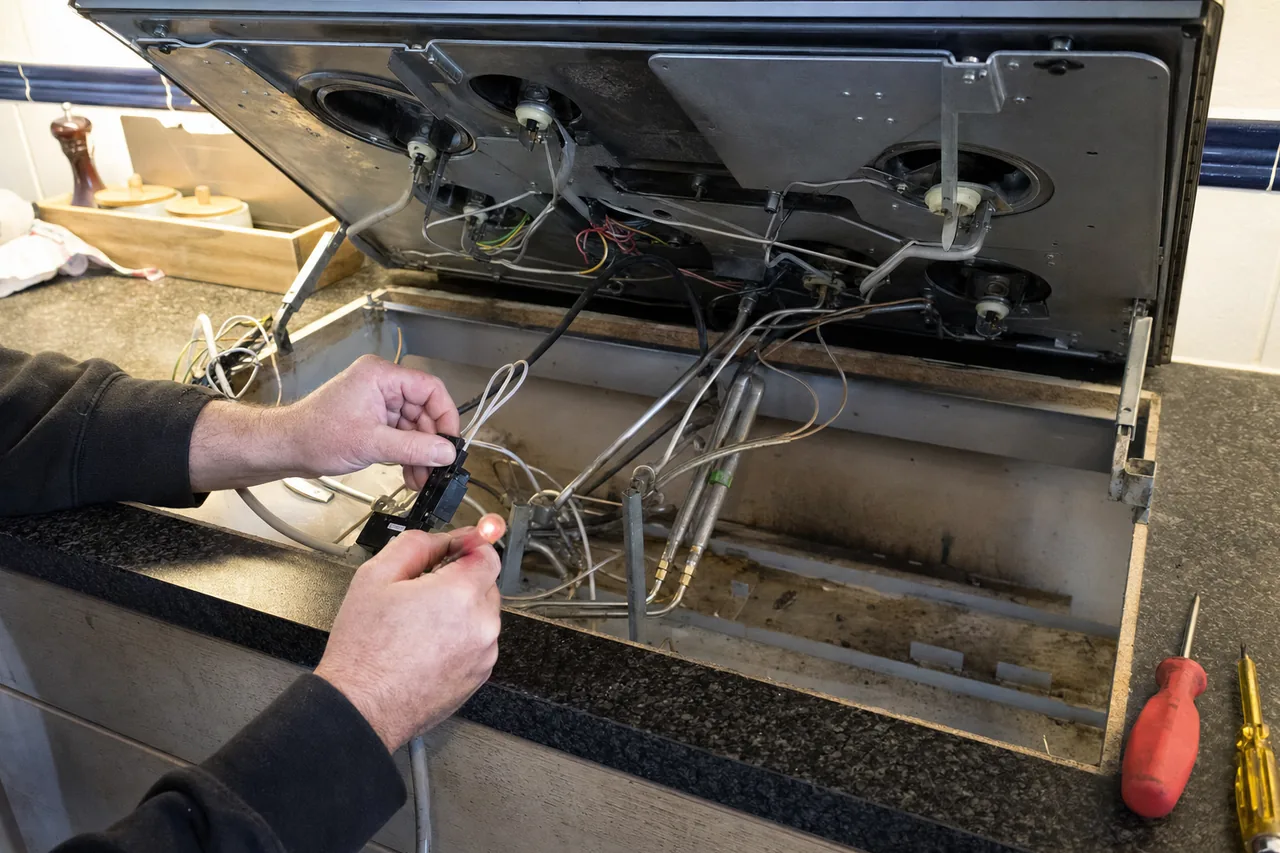
A rangetop is a professional gas cooking surface that drops into a counter with no oven underneath. Most of what we replace on them relates to the low end of the burner range, to griddle thermostats, or to valves that have stiffened with cooking grease.
What we get called for
-
A burner will not hold a true low simmer any more
The low end of a dual-stacked burner depends on a very small, very clean flame path. Even light port blockage or a slightly off-square cap kills the simmer long before it affects the high flame.
-
The knob is stiff, gritty or hard to push in and turn
Cooking grease works past the knob and into the valve stem, then bakes. The valve needs cleaning and regreasing with high-temperature valve grease, not household lubricant.
-
The griddle runs hotter at one end than the other
Usually the griddle thermostat sensor has lost contact with the plate, or the plate has been run empty at high heat often enough to crown slightly in the middle.
-
The charbroiler is slow to light or lights unevenly
Grease and carbon build up around the burner and the igniter on a charbroiler faster than anywhere else on a rangetop, and the igniter gap fills first.
-
The igniters click continuously after the flame is established
A wet electrode or a burner cap sitting proud on one edge. The spark module keeps firing because it cannot sense a flame that is not sitting square over the electrode.
-
The French top or griddle surface has discoloured in rings
Normal heat patterning on a solid cooking surface rather than a fault, though heavy rings can indicate the surface is being run dry at high output for long stretches.
A cooking surface with nothing underneath it
A rangetop is the professional cooking surface without the oven — it drops into a counter, the cabinet below is yours to use, and the ovens usually live in a wall somewhere else in the kitchen. That is the layout in a lot of the newer built-in kitchens in Nocatee, Shearwater and the Pablo Creek Reserve side of Jacksonville, and it changes what breaks. There is no oven cavity, no door hinge, no bake element. Nearly everything that goes wrong is at the burner, the valve, or the accessory module.
The simmer is the canary
The most interesting thing about a professional rangetop is not the high flame, it is the low one. A dual-stacked sealed burner is built to run from a hard sear right down to a flame small enough to hold chocolate or a beurre blanc without breaking it. That low flame is the first thing to go and it is an excellent diagnostic signal.
Here is why. The high flame is fed by a lot of gas through a lot of ports, and losing a few ports to blockage barely changes it. The simmer runs on a small fraction of that flow through a much smaller path, so the same blockage that is invisible at full output makes the simmer sputter, dance or drop out. When someone tells us the burner is fine except that it will not simmer, we already know roughly where we are going.
The second common cause of a lost simmer is a burner cap that is not quite sitting flat. Caps are position-specific on most rangetops and they get shuffled during cleaning. Half a millimetre of tilt does nothing to the high flame and ruins the low one.
Valves stiffen, and grease is why
A rangetop knob should turn with a smooth, even resistance and push in without a fight. When it goes stiff, gritty or notchy, what has usually happened is that cooking grease has migrated down the stem and cooked hard around the valve taper. The fix is to strip the valve, clean it properly and regrease it with a high-temperature valve grease. It is not a job for household lubricant sprayed at the shaft — those thin out at burner temperatures and end up making the problem worse a month later.
Forcing a stiff valve is how valve stems get snapped, and a snapped stem turns a cleaning job into a parts job.
Griddles, charbroilers and French tops
The accessory modules are where the electrical faults live on an otherwise mechanical appliance.
A griddle is temperature-controlled, and its thermostat depends on a sensor sitting in firm contact with the underside of the plate. If that contact is lost, or the plate has crowned from being run empty at high heat, the surface develops a hot band and a cool band and no amount of adjusting the dial fixes it. We check plate flatness before we condemn a thermostat, because a warped plate reads like a thermostat fault.
A charbroiler collects more grease than anything else on the appliance, and the grease finds the igniter gap first. Slow, uneven lighting on a charbroiler is usually a cleaning and gap problem rather than a failed component.
What the coast does
In Ponte Vedra Beach, the Beaches and the older parts of St. Augustine, salt air gets into the burner bases and the fasteners under the cooking surface. Rangetops that live near an open window take it worst. It shows up as fasteners that round off when the surface finally has to come apart, and as surface corrosion in the well under the burners where nobody looks.
How a visit works
We are an independent shop with no manufacturer affiliation, which means our recommendation is not shaped by anyone’s parts program. A visit starts with an $80 flat diagnostic, credited toward the repair if you go ahead with the work, and you get a written estimate before we order anything. Genuine OEM parts, 90 days on labor, 365 days on parts.
What it costs
What does a rangetop repair usually cost?
Every call starts at the same flat $80 diagnostic, credited toward the work once you approve it. The bands below cover part and labor together.
| What gets put right | Typical range |
|---|---|
| Diagnostic visit | $80 flat |
| Oven thermostat or temperature sensor | $190–$520 |
| Igniter or spark module replacement | $210–$500 |
| Burner valve or orifice service | $220–$690 |
Straight answers
Questions we get asked about this
- Why will a burner no longer hold a true low simmer?
- Either the valve stop has worn, so the low position no longer lands where it should, or the port ring is partly blocked and the flame cannot sit steady at low flow. Both are repairable at the valve or at the burner, which is a great deal less than replacing the top.
- Do you repair a Wolf grill — the charbroiler module, or an outdoor gas grill?
- Both. The charbroiler and griddle modules that drop into a rangetop are on this page, and they are the parts of a rangetop that carbon up fastest. Outdoor gas grills are also cooking equipment and inside our scope: igniters, burners, valves and the corrosion that coastal air works into all three. What we do not do is heating and air conditioning, which is a different trade entirely.
- The griddle cooks hotter at one end than the other. Can that be fixed?
- Usually. A plate that has warped, a mount that has dropped, or a thermostat reading at one spot only will each cook unevenly. We level the plate, check the burner beneath it for a hot spot, and verify the surface at several points before calling the job finished.
What this part of Florida does to it
Three local conditions shorten the life of cooking equipment here. These are the ones that matter for this appliance.
- Older kitchens
- A great deal of the housing here predates the equipment now installed in it — the 1900s–1930s streets of Riverside, Avondale and Old Ortega, the 1960s and 1970s houses along Mandarin Road and around Orange Park. Cabinet openings widened by hand leave uneven clearances, dedicated circuits are frequently missing, and anything plumbed or ducted has to follow a route nobody planned for it.
- Salt air
- In the coastal ZIPs — 32082, 32250, 32266, 32233 and 32084 — salt air corrodes hinge pins, exposed fasteners and outdoor ventilation hardware years earlier than it would inland.
Keep reading
Book a diagnostic visit
An $80 flat diagnostic fee covers the visit and the diagnosis, and it is credited toward the repair if you go ahead with the work. You get a written estimate before anything is replaced.
Owner feedback
Owners we did this for
4.9 out of 5 from 95 customer reviews. Each one below is a single visit. Read all 95.
The charbroiler ran hot at one end and barely warm at the other. He cleared a partly blocked orifice, reset the burner in its brackets, and cleaned radiants that had been in there for years.
Florentin P.2026-08-20
One burner kept blowing itself out under the hood on high. He found the air shutter wide open and the flame being pulled sideways, set the shutter right, and rechecked it with the ventilation running.
Casper N.2026-09-05
The wok burner had lost its centre ring flame and only the outer ring would light. He cleared the inner ports, replaced a split gasket under the burner base, and set the flame height on all of them.
Ermintrude S.2026-07-12