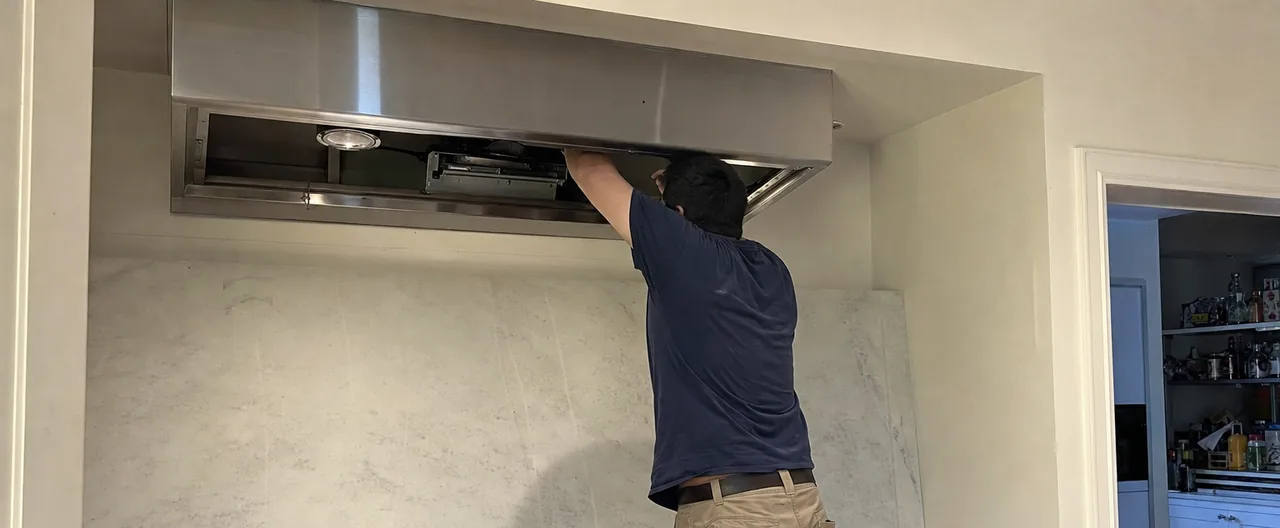
Loud is not the same as working
The most common hood complaint we take is some version of: it is deafening and the kitchen still smells of last night’s fish.
Those two facts usually belong together. A blower moving very little air is frequently louder than one moving a lot, because what you are hearing is turbulence and restriction rather than flow. A hood that has to drag air through clogged baffles, a crushed duct or a half-open damper works hard, makes noise, and achieves very little.
The test takes five seconds. Run the hood on high, hold a sheet of paper flat against the baffles, and let go. It should stick there. If it falls, the system is not moving air, and no amount of new blower is the first answer.
Where the restriction usually is
Four places, in the order we check them.
Baffles. Baffle filters are meant to be pulled out and washed, and when they are not, grease bridges the gaps and the open area collapses. This is the owner’s job, it costs nothing, and it fixes a startling proportion of hood complaints. Do it more often than feels necessary.
The duct run. Every elbow costs airflow. Every foot of horizontal run costs airflow. Flexible duct where rigid should have been used costs a great deal. We cannot rebuild a duct on a service call, but we can tell you plainly when the hood is healthy and the ductwork is the limit, which saves you buying a blower that will not help. This comes up constantly in remodelled kitchens, where a current professional hood has been connected to a duct that was routed decades ago for something far smaller.
The damper. A backdraft damper is a set of light flaps that should open under airflow and fall closed when the hood stops. Grease gums them. Salt corrodes the pivots — in Neptune Beach, Ponte Vedra Beach and the older parts of St. Augustine, the outdoor cap is usually the first thing to go. A damper stuck half open strangles the system; one that will not close lets outside air, humidity and insects back down the duct.
The blower itself. Last, not first. Bearing wear and grease build-up on one side of the wheel put it out of balance, and an unbalanced wheel gets progressively louder until it takes the motor with it. External and in-line blowers mounted in an attic, on a roof or on an outside wall are the ones that go first, because they are exposed.
The makeup air question
If your hood is a serious one and your house is reasonably new, there is a second question: where is the replacement air coming from?
A hood can only exhaust what the house can let back in. Pull several hundred cubic feet a minute out of a tight house and the interior goes negative. Interior doors pull themselves shut. The front door takes effort to open. And extraction falls well short of what the blower’s rating suggests, because the blower is fighting the house rather than the cooking.
The residential code requires makeup air for kitchen exhaust systems rated over 400 CFM, and that requirement exists precisely for this. In practice we see it most in the newer construction — Nocatee, Shearwater, SilverLeaf, the recent Jacksonville builds — which are built to a far tighter envelope than a 1960s Mandarin ranch house. The older Riverside and Avondale kitchens have the opposite situation: they leak enough that makeup air was never the constraint, but their duct runs were improvised long ago and are usually the limit instead.
What we check on a hood call
Airflow at the baffles, baffle condition, damper operation at both ends of the duct, blower balance and bearing noise, and the control side. Then we tell you which of those is your actual problem, including when the answer is that the hood is fine and the ductwork or the house is the constraint.
We are an independent shop. We would rather give you an honest answer that does not involve a part than sell you a blower that will not fix anything. The visit is an $80 flat diagnostic, credited toward the repair.
Common follow-ups
How do I test whether my hood is moving air?
Run it on high and hold a sheet of paper flat against the baffles. It should pin itself there and stay. If it drops, the system is not moving meaningful air and the problem is somewhere between the baffle and the outdoors.
Why do my interior doors pull shut when the hood is on?
The hood is exhausting more air than the house can replace, so the interior goes slightly negative. That is the classic sign of a kitchen that needs makeup air, and the residential code requires it for exhaust systems rated over 400 CFM.
If the house needs makeup air, do you install it?
No. We can measure what the hood is actually moving and tell you whether makeup air is the constraint, which is the part of the question an appliance shop can answer honestly. Supplying it means a duct, a damper and usually an interlock, and that is mechanical contracting. We do not do heating, air conditioning or the ducted system that serves the house, and we will name what is needed rather than pretend it is ours.
Can baffle filters go in the dishwasher?
Baffle filters are designed to be removed and washed, and a dishwasher is the usual way. Doing it regularly is the single most effective maintenance a hood owner can perform, because grease bridging the baffle gaps collapses the open area.