What we fix
Wolf gas range and gas stove repair
An all-gas range burns gas on top and in the oven, so the oven has an ignition circuit a dual-fuel range does not. Most of the calls we take on these are ignition timing, blocked ports, or a safety valve that is no longer being told to open.
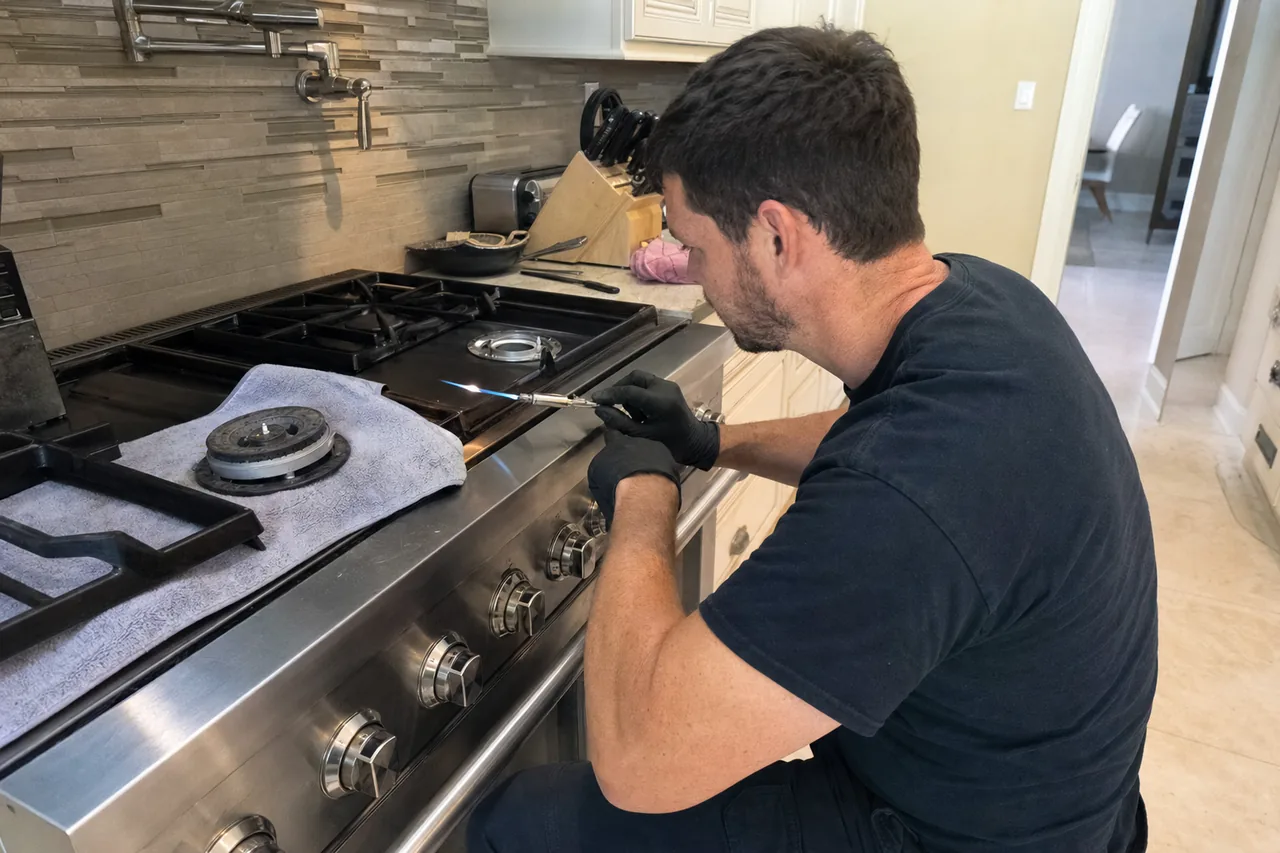
What we get called for
-
The oven takes several minutes to light, then lights with a thump
A tired oven igniter. The igniter is also the current sensor for the gas safety valve, so as it ages it glows without drawing enough current to open the valve promptly. Gas pools while it tries.
-
The oven does not light at all, but the cooktop burners work
The cooktop and the oven are on separate ignition systems. A dead oven with live burners usually means the oven igniter has failed open, or the safety valve is not opening.
-
The igniter clicks on and on after the burner has lit
Nearly always a wet electrode or a burner cap seated slightly proud on one side. The spark module keeps firing because it cannot sense a flame that is not sitting where it expects.
-
One burner has a ragged flame or will not hold a low simmer
A blocked port ring from a boil-over, or a cap that has been put back on the wrong base. Burner caps and bases are sized per burner and they do get swapped after cleaning.
-
The broiler lights but the flame is patchy across the burner
Grease and carbon in the broiler ports, or a burner that has warped slightly from repeated heat cycling and no longer sits parallel to the deck.
-
There is a faint gas smell for a second or two at ignition
Usually delayed ignition from a slow igniter or a partially blocked port, which lets a small amount of gas accumulate before the flame catches. It should be looked at rather than lived with.
Gas top, gas oven, two different ignition problems
An all-gas range lights its oven with gas, and that one difference changes the whole diagnostic conversation. On the cooktop a spark module throws a spark across an electrode gap and the flame either catches or it does not. In the oven an igniter has to glow hot enough both to ignite the gas and to draw enough current through the safety valve circuit to hold that valve open. A clever arrangement, with one very characteristic failure.
An oven igniter does not usually die, it weakens. It still glows, so it looks fine through the vent, but it no longer pulls the current the valve needs to open on time. The oven takes two, then three, then five minutes to light, and finally lights with an audible thump because gas has had time to collect before ignition. Owners describe that as slow preheating. It is not preheating slowly, it is not lighting, and the delay only ever gets longer.
The cooktop side
Sealed burners are simple and they break in a short list of ways.
An igniter still clicking after the flame is up is the call we get most often, and roughly half the time the owner fixes it in two minutes with a paper towel. Something boiled over, liquid wicked down to the electrode, and the module is blind to a flame burning right in front of it. Dry the electrode, lift the cap and set it back down square. If it still clicks, the electrode ceramic is probably cracked and the spark is leaking to ground.
Uneven flame is the second: a ring burning tall on one side and lazy on the other has partly blocked ports, which is a cleaning job rather than a gas-supply problem. The third is not a fault at all — one spark module drives every electrode, so all of them fire when you turn one knob, by design.
Burner caps are worth a mention too. They are not interchangeable across positions on most ranges, and after a thorough clean they frequently come back in the wrong spots. A cap on the wrong base sits at the wrong height over the ports and gives you exactly the symptoms of a failing burner.
Old kitchens, new ranges
A good number of these ranges live in kitchens that were never designed around them. The 1900s through 1930s houses in Riverside, Avondale and Old Ortega have cabinet openings sized for a 30-inch range, so a 36-inch professional range means rebuilding a cabinet run. Those installations end up tight on clearance and short on air at the back, and a range that cannot breathe runs hot at the control panel and takes its electronics with it.
The electrical side surprises people. An all-gas range still needs power for the spark module, the oven control and the light, and older kitchens frequently have no dedicated circuit behind the range. Sharing one with a counter full of small appliances causes intermittent faults that look like a failing board.
Salt air on the coast
The beach ZIPs are hard on ranges in a slow, unglamorous way. Salt gets into hinge pins, into the fasteners along the back panel and into the burner bases if the cooktop is not wiped. Nothing fails in a single event: doors stop closing quite square, screws round off when somebody finally needs to remove them, and stainless pits along the edges where it is never dried.
Working with an independent shop
We are independent. We are not part of any manufacturer service network, which means we tell you what the appliance actually needs and we fit genuine OEM parts.
What it costs
What does a gas range repair usually cost?
Every call starts at the same flat $80 diagnostic, credited toward the work once you approve it. The bands below cover part and labor together.
| What gets put right | Typical range |
|---|---|
| Diagnostic visit | $80 flat |
| Igniter or spark module replacement | $210–$500 |
| Burner valve or orifice service | $220–$690 |
| Oven thermostat or temperature sensor | $190–$520 |
Straight answers
Questions we get asked about this
- Why does the oven take minutes to light and then light with a thump?
- The oven igniter is also the current sensor for the gas safety valve. As it ages it still glows but no longer draws enough current to open that valve promptly, so gas collects while it tries. The delay only ever lengthens, which is why it is worth diagnosing before it becomes a no-ignition call.
- The stove clicks but will not light. What is wrong?
- Clicking without a flame means the spark is arriving and the gas is not, or not where the spark is. In order of likelihood: a burner cap seated crooked so the spark lands away from the port ring, a wet or cracked electrode after a boil-over or a clean, a blocked port ring, or gas that is not reaching the burner at all. Dry the electrode, lift the cap and set it square on its own base first — that is a two-minute check and it settles a good share of these calls.
- Is it normal for every igniter to click when I turn one burner?
- Yes. One spark module drives every electrode on the cooktop, so they all fire together by design. Clicking that carries on after the flame is up is a different thing: usually a wet electrode or a cap sitting proud on one side, and often cured by drying it and setting the cap back square.
What this part of Florida does to it
Three local conditions shorten the life of cooking equipment here. These are the ones that matter for this appliance.
- Older kitchens
- A great deal of the housing here predates the equipment now installed in it — the 1900s–1930s streets of Riverside, Avondale and Old Ortega, the 1960s and 1970s houses along Mandarin Road and around Orange Park. Cabinet openings widened by hand leave uneven clearances, dedicated circuits are frequently missing, and anything plumbed or ducted has to follow a route nobody planned for it.
- Salt air
- In the coastal ZIPs — 32082, 32250, 32266, 32233 and 32084 — salt air corrodes hinge pins, exposed fasteners and outdoor ventilation hardware years earlier than it would inland.
Keep reading
Book a diagnostic visit
An $80 flat diagnostic fee covers the visit and the diagnosis, and it is credited toward the repair if you go ahead with the work. You get a written estimate before anything is replaced.
Owner feedback
Owners we did this for
4.9 out of 5 from 95 customer reviews. Each one below is a single visit. Read all 95.
Flames were lifting off the ports and burning yellow. He measured manifold pressure, found the regulator had drifted after the meter was changed out, and set it back where it belongs. Blue and steady now.
Ludovic B.2026-06-30
The oven under the range was running about thirty degrees cool. He hung his own thermometer, watched two full cycles, then reset the calibration. My bread finally rises the way the recipe says it should.
Ilona P.2026-07-26
Every burner lit except the one we use most, which sparked at the wrong electrode entirely. He found a cracked ceramic and a cap that had gone back on the wrong base after a clean. Both put right in an hour.
Marguerite V.2026-09-11