What we fix
Wolf induction cooktop repair
An induction cooktop has no flame and almost no moving parts, so when one misbehaves the cause is usually the cookware, the cooling airflow underneath it, or a power board that has been sitting in a hot, unventilated cabinet.
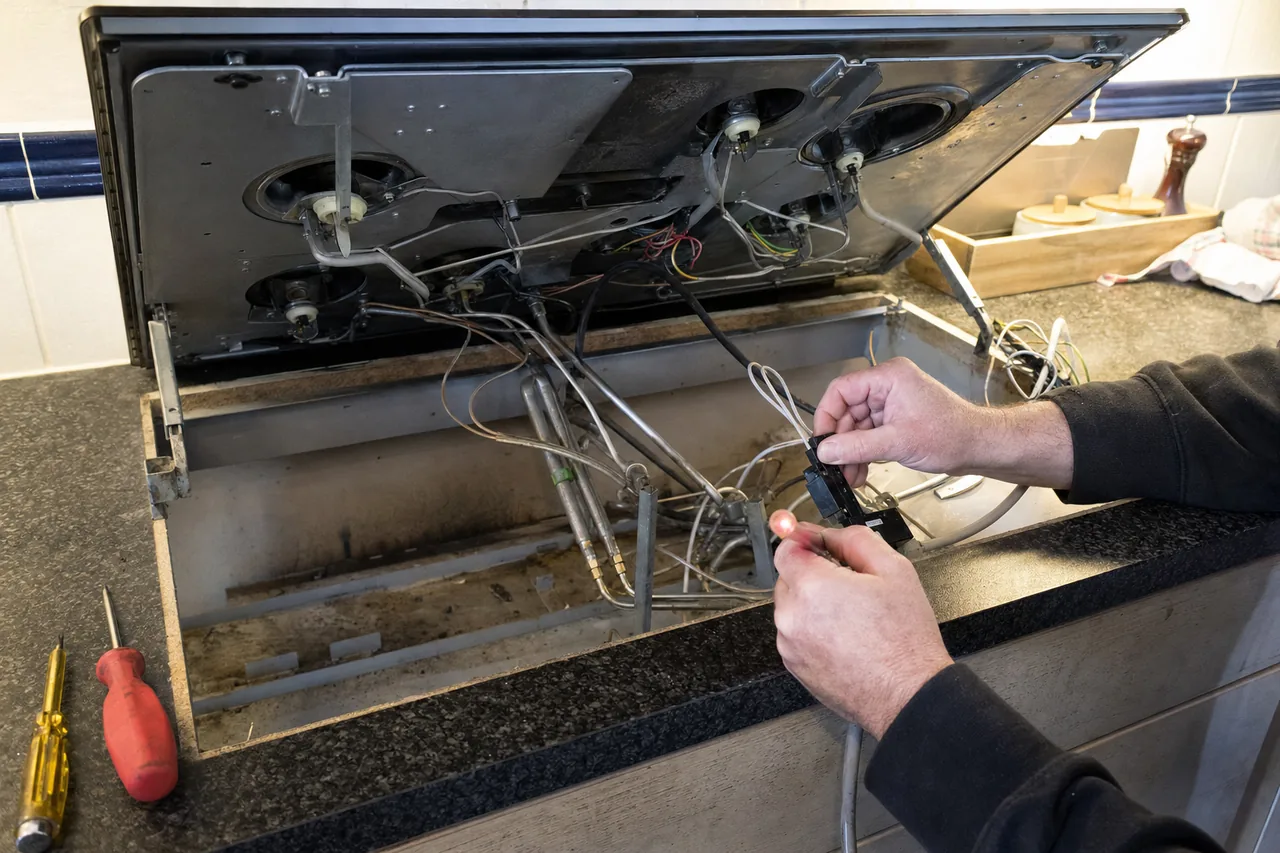
What we get called for
-
The cooktop does not recognise a pan that used to work
Induction needs a ferrous base with enough contact area. Warped bases, thin clad pans and pans smaller than the element ring all read as no pan at all to the detection circuit.
-
An element runs at full power then drops back on its own
Thermal cutback. The electronics under the glass are air-cooled, and when the intake or the exhaust is obstructed the cooktop protects itself by reducing power before anything is damaged.
-
The touch controls stop responding or behave erratically
Capacitive controls read a film of water or a wet cloth as a finger. Persistent unresponsiveness after the glass is dry and clean points at the control board or its ribbon connection.
-
The fan keeps running for a long time after cooking has finished
That is normal. The cooling fan continues until the electronics under the glass are back down to temperature, which can take several minutes after a long high-power session.
-
There is a buzz or hum from the pan at high power
Usually the cookware, not the cooktop. Multi-layer clad bases can resonate audibly at high output, and lighter pans buzz more than heavy ones.
-
The glass has cracked or chipped at an edge
Impact damage or, occasionally, stress from an installation where the cutout is tight and the top is bearing on the countertop rather than resting on its own supports.
Nothing burns, so the diagnosis changes
An induction cooktop makes heat in the pan, not on the glass. A coil under the surface generates an alternating magnetic field, and the pan’s own steel resists it and gets hot. The glass warms up only because the pan is sitting on it. That is why the surface cools so quickly and why a spill on an induction top wipes off instead of baking on.
Diagnostically, it means most of the classic cooktop symptoms are gone. There is no flame to be uneven, no igniter to click, no burner cap to seat. What replaces them is a smaller list of electrical and thermal problems, plus one category that is not a fault at all — the cooktop doing exactly what it should with cookware that cannot work on it.
Pan detection is usually the cookware
By far the most common call is a pan that used to work and now does not, or a new pan that never worked. Induction needs a ferrous base with real contact area under the element. Three things break that:
A base that has warped. Pans bow upward in the middle after enough thermal cycling, and once the centre lifts, the coupling drops off. The pan may still sit flat enough to look fine on the counter.
A base that is only partly magnetic. Some clad pans have a thin magnetic disc sandwiched in the middle of the base, and once it is worn or delaminated the coupling becomes marginal — the element cycles on and off as detection comes and goes.
A pan that is simply too small for the ring it is on. Detection has a minimum diameter. Move a small saucepan to a smaller element and it usually wakes up.
The two-minute test costs nothing: press a refrigerator magnet against the base. It should grab hard, and it should grab across the whole bottom, not just in the centre.
Heat under the glass is the real enemy
Everything clever about an induction cooktop lives in a thin space between the glass and the cabinet below, and it is cooled by moving air across it. That is the part installers get wrong most often. If a drawer front, a filler panel or a stack of baking trays blocks the airflow path, the cooktop will keep working — it simply pulls its own power back so the electronics stay inside their limits. Owners describe this as an element that loses its heat halfway through cooking. It is the appliance protecting itself.
Before we condemn a power board, we check what the airflow underneath is actually doing. In more than a few kitchens the fix is emptying a drawer.
Storms, boards and this part of Florida
Induction cooktops are power electronics. This area sees roughly 68 thunderstorm days a year, and a surge that a resistive appliance would shrug off can take out an inverter board or its control side. The frustrating part is that surge damage rarely presents as a dead cooktop. It presents as one element that works intermittently, a display that lights but does not respond, or a cooktop that runs fine for twenty minutes and then quits. We check the supply, then the boards, in that order.
Salt air is less of a factor here than it is on a gas appliance — there are fewer exposed fasteners and no burner bases to corrode — but coastal kitchens still see corrosion at the terminal block and on the chassis under the glass.
What a visit looks like
We are an independent repair company, not part of any manufacturer network, and we will tell you plainly when the answer is cookware or ventilation rather than a part. The visit is an $80 flat diagnostic, credited toward the repair, with a written estimate before anything is ordered. Genuine OEM parts, labor warranted 90 days, parts warranted 365 days.
What it costs
What does a induction cooktop repair usually cost?
Every call starts at the same flat $80 diagnostic, credited toward the work once you approve it. The bands below cover part and labor together.
| What gets put right | Typical range |
|---|---|
| Diagnostic visit | $80 flat |
| Control board or touch panel | $440–$1,050 |
| Oven thermostat or temperature sensor | $190–$520 |
| Door hinge, glass or seal | $200–$690 |
| Convection fan or motor | $260–$660 |
Straight answers
Questions we get asked about this
- The cooktop stopped recognising a pan it used to work with. Is it broken?
- Not always. Detection depends on the base staying flat and magnetic, and a warped or worn pan can drop out of range while the cooktop is perfectly healthy. We test the zone with a known pan first; if it reads ours and not yours, the answer has cost you nothing but the visit.
- Why does the cooktop shut a zone down partway through cooking?
- Induction electronics sit under the glass and are cooled by a small fan. A blocked cabinet vent, a choked fan or a failing power module all end the same way: the board protects itself and drops the zone. The cause is far more often airflow than the cooktop itself.
What this part of Florida does to it
Three local conditions shorten the life of cooking equipment here. These are the ones that matter for this appliance.
- Storm season
- This area sees roughly 68 thunderstorm days a year. Control boards fail after surges, and they fail in ways that look like an unrelated mechanical fault.
Keep reading
Book a diagnostic visit
An $80 flat diagnostic fee covers the visit and the diagnosis, and it is credited toward the repair if you go ahead with the work. You get a written estimate before anything is replaced.
Owner feedback
Owners we did this for
4.9 out of 5 from 95 customer reviews. Each one below is a single visit. Read all 95.
A hairline crack had opened at the edge of the glass and the panel began faulting. He sourced the correct glass top, fitted it without rushing, and resealed the perimeter so nothing can work its way under.
Emiliano I.2026-07-30
Touch controls responded to nothing in the morning and behaved perfectly by the afternoon. Moisture was tracking under the panel from a slow leak at the sink above. He dried it, sealed the run, and it is reliable.
Cordula B.2026-07-21
The timer on the hob would count down and then forget to switch the zone off. He replaced the touch control assembly, checked each zone against the new panel, and went through the settings with me.
Radoslav P.2026-07-21