What we fix
Wolf convection steam oven repair and descaling
A convection steam oven is a conventional oven with a boiler, a drain and a humidity-tight door added to it. That is four more things to go wrong, and most of them announce themselves the same way: steam that is not what it used to be.
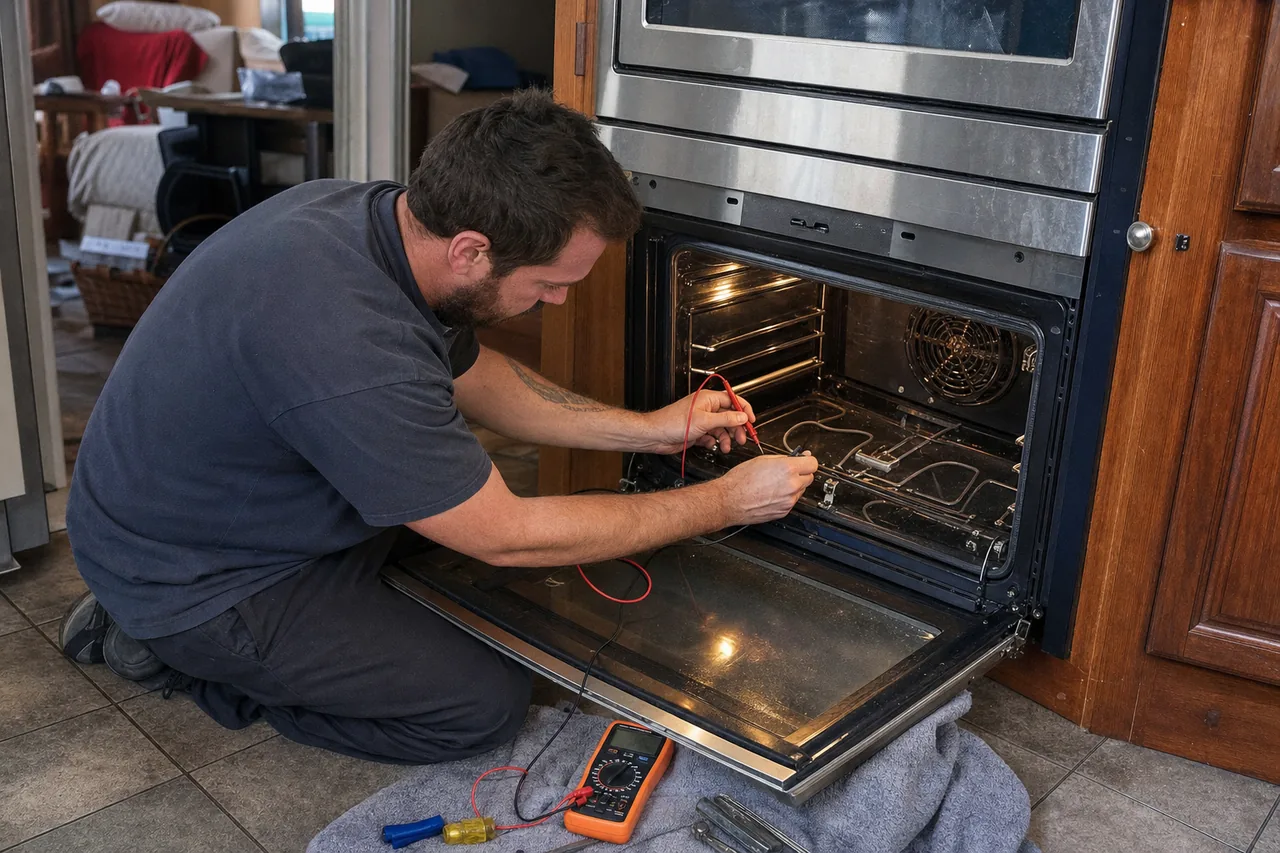
What we get called for
-
Steam is weak, slow to build, or does not appear at all
Deposits on the heating element act as insulation. The element gets hotter, the water gets less heat, and steam output falls off gradually — long before anything actually fails.
-
Water sits in the bottom of the cavity after a cycle
A restricted drain path or condensate channel. Everything that carries water away from the cavity is somewhere minerals and food residue can settle out, and it restricts long before it blocks.
-
The reservoir empties much faster than it used to
Usually a door seal that has hardened and stopped sealing along part of its length, so steam escapes the cavity and the generator keeps making more to compensate.
-
Cycles abandon themselves partway, or a fill never satisfies
Often the level-sensing arrangement rather than the control board. An oven that cannot measure its own water behaves in ways that look convincingly electrical.
-
A descale cycle was run but the symptoms came straight back
A cycle strips the accessible deposits. Where a hard layer has been building for a year or more the rest stays behind, and the generator needs opening and cleaning mechanically.
-
The oven runs but the food comes out drier than it should
Reduced steam output, sometimes from the generator, sometimes from a gasket that has hardened. Steam cooking is unforgiving of small losses in humidity.
-
The control board fails after a storm
Steam ovens combine electronics with water, and surge damage often shows up as one mode that no longer works while the rest of the oven appears healthy.
Four extra systems, one shared symptom
Strip away the steam and this is an oven: element, fan, sensor, board, door. Add the steam and it also has a generator that boils water on purpose, a supply either plumbed or filled by hand, a way of measuring what it is holding, and a drain path for what condenses out. Four extra systems, three of which fail in a way the cook experiences identically — as steam that has quietly weakened.
So we do not diagnose this appliance from a description. Weak steam with a dry cavity, weak steam with water standing in the bottom, and weak steam with a reservoir emptying in half the usual time are three different repairs, and the difference is visible in ten minutes with the oven running.
Municipal water here is hard, which matters more to a steam oven than to anything else in a kitchen: a generator boils tap water as its whole method of operation, and everything the water was carrying stays behind. The response is simple. Descale on a calendar set by how much steam you use rather than waiting to be prompted, and fill a reservoir model with filtered water.
What the deposits actually do
They insulate. As the layer thickens on the heating element, less of its heat crosses into the water and more stays in the element. Two consequences follow, in this order: steam output drops, which the cook reads as longer cycles and drier food, and the element runs hotter than it was designed to, which is eventually what kills it.
Downstream of the generator, minerals settle wherever water slows down: the drain path, the condensate channel, the level-sensing surface. A crusted sensing surface reads wrong, and an oven that misreads its own water level produces faults that look electrical and get diagnosed as a board. That is the most expensive wrong turn on this appliance, and the reason we measure before we condemn anything.
Plumbed or reservoir, and what it changes about the job
A plumbed oven takes water from the house supply through a small line behind the cabinetry. A reservoir oven is filled by hand from a tank in the fascia.
For the owner the difference is what you can put in it; for us it is access. A plumbed installation has to be isolated and disconnected before the appliance can move, and the line routed back the way it came — in an older kitchen, often an improvised path. A reservoir model has no such constraint, which shortens several jobs.
Either way this is cabinet-mounted equipment: heavy, accessed from the front, and any repair reaching behind the generator means bringing the oven out of its opening with the cabinetry cleared and the weight supported. Worth hearing at the estimate rather than halfway through — a cheap part can be a long job, and an expensive-sounding part is occasionally twenty minutes away.
What we do on a visit
We run the appliance and watch it build steam, checking output, the generator, the level sensing, the drain path and the door seal — the seal along its whole length, with the door closed, because the part of a gasket that has stopped working is rarely the part you can see. We check the supply and the board where the symptom pattern points that way, particularly after a week of storms.
Then you get a written estimate. Parts are ordered against the model and the serial number rather than the model alone, because components on this equipment are revised mid-production and the correct one depends on where your appliance falls in that sequence — a photograph of the rating plate saves a return trip.
We are an independent repair company, not part of any manufacturer service network, and we fit genuine OEM parts.
What it costs
What does a convection steam oven repair usually cost?
Every call starts at the same flat $80 diagnostic, credited toward the work once you approve it. The bands below cover part and labor together.
| What gets put right | Typical range |
|---|---|
| Diagnostic visit | $80 flat |
| Control board or touch panel | $440–$1,050 |
| Oven thermostat or temperature sensor | $190–$520 |
| Convection fan or motor | $260–$660 |
| Door hinge, glass or seal | $200–$690 |
Straight answers
Questions we get asked about this
- A descale was run but the symptoms came straight back. What is going on?
- A descale program cleans the boiler, not the level sensor and not a silted drain. If the sensor is fouled the oven keeps reporting a water fault with a full tank, and if the drain is kinked the cycle never completes. Both are cleaned by hand rather than by a program.
- Which descaler should I put through a Wolf steam oven?
- The descaling solution the manufacturer specifies for that oven, at the dose printed on its bottle, and nothing improvised. Vinegar and household limescale removers are too aggressive for the seals and the level-sensing hardware, and an oven that has had them through it tends to arrive with a leak as well as scale. If a proper descale has already been run and the steam is still weak, the deposit is past what any solution reaches and the generator needs opening.
- Does hard water really shorten the life of a steam oven?
- It shortens the interval between descales more than it shortens the life of the oven. Scale settles on the heater, the level sensor and the valve seats, and an oven descaled on a sensible interval will comfortably outlast one that is only descaled when it starts to complain.
What this part of Florida does to it
Three local conditions shorten the life of cooking equipment here. These are the ones that matter for this appliance.
- Older kitchens
- A great deal of the housing here predates the equipment now installed in it — the 1900s–1930s streets of Riverside, Avondale and Old Ortega, the 1960s and 1970s houses along Mandarin Road and around Orange Park. Cabinet openings widened by hand leave uneven clearances, dedicated circuits are frequently missing, and anything plumbed or ducted has to follow a route nobody planned for it.
- Storm season
- This area sees roughly 68 thunderstorm days a year. Control boards fail after surges, and they fail in ways that look like an unrelated mechanical fault.
Keep reading
Book a diagnostic visit
An $80 flat diagnostic fee covers the visit and the diagnosis, and it is credited toward the repair if you go ahead with the work. You get a written estimate before anything is replaced.
Owner feedback
Owners we did this for
4.9 out of 5 from 95 customer reviews. Each one below is a single visit. Read all 95.
The steam oven stopped partway through and asked to be descaled again right after a descale. He found the level sensor fouled rather than the boiler, cleaned it by hand, and ran the cycle through to the end.
Valentina C.2026-09-15
It heated but never steamed properly and everything came out dry. The pump was drawing air past a perished inlet seal. He replaced the seal and the pump, then ran a full test bake with bread in it.
Seraphine L.2026-09-03
Water sat in the bottom of the cavity after every cook. The drain had silted up where it turns behind the cabinet. He cleared the line, flushed it through, and set the oven to dry itself down at the end.
Nikolaus F.2026-09-09