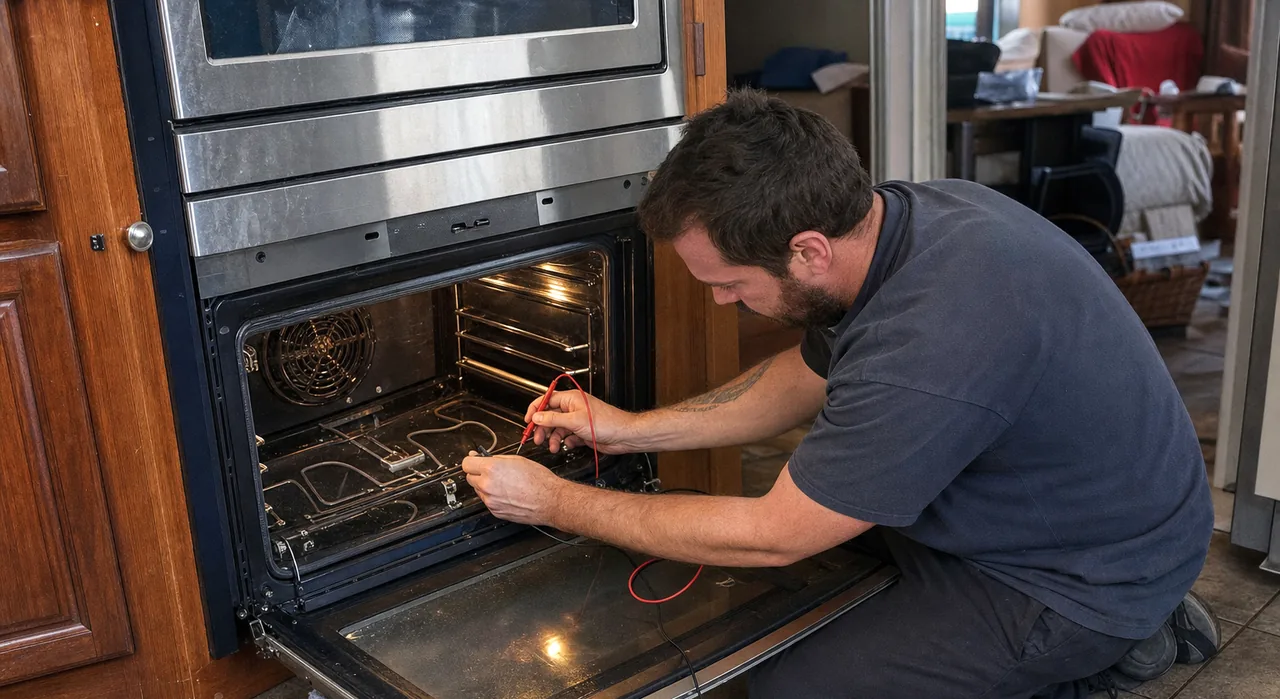
A short list, but not a simple one
A convection steam oven does everything a conventional oven does and then adds water to the problem. It has a heating element, a fan and a control board like any other oven, plus a steam generator, a water supply of some kind, a level-sensing arrangement, a drain path, and a door seal that has to hold humidity rather than only heat.
The good news is that the list of things which actually fail is short. The awkward part is that several of them announce themselves in the same way — as steam that is not what it used to be — so the diagnosis is about separating them rather than recognising one.
Falling steam output
This is the most common call we take on this appliance, and it is almost never sudden. Deposits build on the hottest surface in the generator, which is the heating element, and they insulate it. Less of the element’s heat crosses into the water, more of it stays in the element, and two things follow in that order: output drops, and the element runs hotter than it was designed to.
The first stage is experienced as cooking rather than as a fault. Cycles run long. Food comes out drier than it did two years ago. Bread proves badly. Very few people call an appliance company about that, which is why the second stage — the element failing outright — arrives as a surprise to the owner and as an entirely predictable event to us.
Water in the wrong place
Water standing in the cavity after a cycle, or a puddle appearing under the door, is usually a restriction rather than a breakage. Everything that carries water away from the cavity — the drain path, the condensate channel and the arrangement below it — is somewhere minerals and food residue can settle out, and a restricted drain shows itself well before it blocks completely.
A door seal that has hardened produces a similar picture from the opposite direction. Steam escapes past it, the generator keeps making more to hold the setpoint, the reservoir empties faster than it used to, and the cabinetry above the door starts to show the damp. On a first visit we check the seal along its whole length with the door closed on a strip of paper, because the part of a gasket that has stopped sealing is rarely the part you can see.
Level sensing, and the faults that look electrical
The oven has to know how much water it is holding. When the sensing surface develops a crust it reads wrong, and an appliance that misreads its own water level behaves in ways that look convincingly like a control fault: cycles that abandon themselves partway, a fill that never satisfies, an error state that clears on its own and returns the following week.
This is exactly the fault we are trying to stop people paying for twice. Replacing a board because the appliance behaved erratically, when the appliance behaved erratically because it could not measure its own water, is an expensive way to change nothing.
Getting to it
Steam ovens are cabinet-mounted, they are heavy, and the service access is from the front rather than from behind. Where a generator assembly has to come out, the oven generally has to come out of its opening first, which means clearing the cabinetry, supporting the weight, and — on a plumbed model — isolating and disconnecting the supply before anything moves.
That is worth knowing before the estimate rather than after it. A cheap part can still be a long job if it sits behind the generator, and a part that sounds serious can occasionally be reached in twenty minutes. We say which one it is, in writing, before anything is ordered.
Parts are ordered against the model and the serial number, not the model alone. Manufacturers revise components mid-production, and on this equipment the correct seal, sensor or assembly frequently depends on where the appliance falls in that sequence. A photograph of the rating plate — usually behind the door or along an edge of the frame — is the fastest way to get it right first time, and it is the difference between a part arriving once and a part arriving twice.
Maintenance, honestly
Descaling is maintenance rather than repair, and it is the single thing that decides how long a generator lasts. Put it on a calendar set by how much steam you actually use rather than waiting for the appliance to prompt you, because the prompt is generally counting cycles rather than measuring anything. If the oven is a reservoir model you fill by hand, filling it with filtered water costs a jug and a habit and will add years to the generator.
There is a point past which chemistry stops being enough. If a descale cycle restores performance for a week and then it fades again, the accessible deposits came off and a hard layered one stayed behind. At that point the generator has to be opened and cleaned mechanically, and no number of further cycles will get there.
When it is worth repairing
Built-in equipment is worth repairing for longer than freestanding equipment is, because replacing it is rarely just the appliance: the opening, the trim and sometimes the run of cabinetry either side are part of the decision. A seal, a sensor, an element or a board on an otherwise sound oven is normally the cheaper end of that comparison by a wide margin.
We will tell you when it is not. If a long-standing problem has been left to run and the damage has spread beyond one component, we would rather say so than sell a repair we do not believe in. We are an independent shop, and nobody is measuring us on parts sold.
Common follow-ups
Why has the steam got weaker without anything breaking?
Because output falls gradually rather than stopping. Deposits build on the heating element as an insulating layer, so less of the element's heat crosses into the water, and the cook experiences that as longer cycles and drier food rather than as a fault. This stage can run for a year before anyone calls.
There is water left in the cavity after a cycle. Is that serious?
It usually means the drain path or the condensate channel is restricted rather than that anything has failed. It is worth dealing with early, because standing water keeps the door seal and the cavity floor wet between uses and turns a cleaning job into a parts job.
Can a steam oven fault damage the cabinetry around it?
It can, and that is the reason not to live with one. A door seal that has stopped sealing along part of its length lets steam out at the top of the door, and the cabinetry immediately above it takes that steam every time the oven runs. Fixing a gasket is inexpensive; refinishing joinery is not.
Is a reservoir steam oven better than a plumbed one?
Neither is better built. A reservoir model is filled by hand, which means you can put filtered water into it, and doing that consistently is the cheapest maintenance decision available to a steam oven owner. A plumbed model takes whatever the kitchen branch supplies unless the house treats it upstream.
How long does a steam oven repair usually take?
The diagnosis is normally one visit. Whether the repair happens on the same visit depends on the part: seals, sensors and common electrical components are stocked, while generator assemblies and board-level parts are ordered against the model and serial number and take longer to arrive.