What we fix
Wolf warming drawer repair
A warming drawer is the simplest appliance in a built-in kitchen and the one people notice last when it fails. It holds a narrow, low temperature band, and almost everything that goes wrong is the element, the thermostat, the humidity vent or the glides.
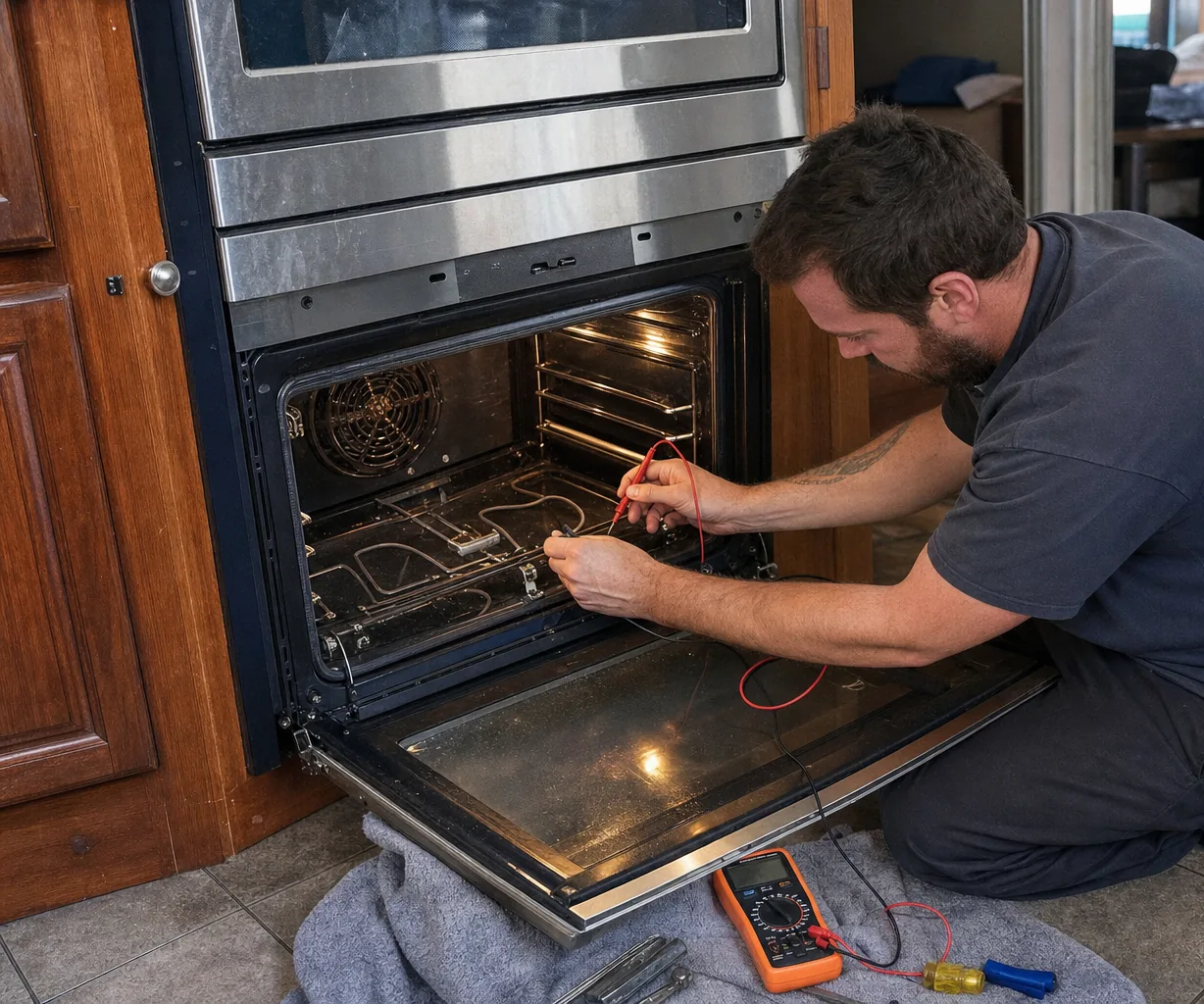
What we get called for
-
The drawer no longer gets warm at all
Usually the element or its circuit. Warming drawer elements run at low wattage for long stretches, and they fail open quietly with nothing to see and nothing to smell.
-
Plates come out hot but bread comes out leathery
The moisture vent is open when it should be closed, or the seal around the drawer front is no longer holding humidity in. Warming drawers hold moisture as much as heat.
-
Food dries out or scorches on the lowest setting
A thermostat or sensor drifting high. The whole useful range of a warming drawer is narrow, so a small calibration error is a large proportion of the setting.
-
The drawer sticks, drags or no longer closes square
Worn or bent glides, usually from being loaded with a heavy stack of plates and pushed shut hard. A drawer that does not close square loses heat continuously along one edge.
-
Condensation collects inside the drawer
Moist food held with the vent closed and the drawer opened frequently. It becomes a fault only when it persists with the vent open, which points at the vent mechanism itself.
-
Proofing dough rises unevenly or not at all
Proofing sits at the very bottom of the temperature range, where sensor drift has the largest effect. A drawer that is 15 degrees high at proof temperature will kill the rise it is supposed to help.
Small appliance, narrow band, easy to misjudge
A warming drawer does one thing: it holds a low, steady temperature — roughly from proofing warmth at the bottom of its range to something just under a simmer at the top, depending on the model — while managing how much moisture stays inside. That is the entire job. There is no fan roar, no flame, no water. It is the least dramatic appliance in a built-in kitchen and the one most people forget they own until a holiday, which is when it gets discovered broken.
Because the useful range is so narrow, calibration errors that would be invisible in a wall oven are obvious here. An oven that reads 15 degrees high at 375 is annoying. A warming drawer that reads 15 degrees high at proofing temperature will not proof dough — it will kill the yeast’s rise and set a skin on the surface, and the owner will conclude the drawer does not work.
The moisture control does more than people expect
The single most common call that turns out not to be a fault is about texture rather than heat. Bread rolls come out leathery. Fried chicken goes soft. Plates are hot but the food on them is not right.
Nearly every warming drawer has a moisture vent, and it is the control that gets ignored. Open the vent and moisture escapes, which is what you want for anything that should stay crisp. Close it and moisture stays in, which is what you want for bread, tortillas or anything that dries out. Getting that backwards makes a perfectly healthy drawer look broken.
Where it does become a fault is when the vent mechanism sticks, or when the gasket around the drawer front has hardened and no longer holds humidity in regardless of what the vent is doing. Both are fixable.
Heating faults are usually simple
When a drawer genuinely stops heating, the list is short: the element, the thermostat or sensor, the control, or the supply. Warming drawer elements run at low wattage over long periods, and when they fail they usually fail open — no bang, no smell, no discolouration, just a drawer that is room temperature after an hour. That is easy to confirm with a meter and rarely turns into a long job.
Sensor drift is the more interesting one because it does not present as a failure. It presents as food that is not right. If the top of the range now scorches and the bottom of the range no longer proofs, we are looking at calibration rather than a dead component.
Glides, weight and the door that no longer sits square
Warming drawers get loaded with heavy stacks of plates and then shut with a hip. Over years that bends glides and wears rollers, and the drawer starts to drag, then sits fractionally proud on one side when closed. A drawer that does not close square leaks heat along that edge continuously, which shows up as a drawer that takes forever to come up to temperature and never quite holds it. Owners almost never connect the sticky drawer with the poor heating. They are the same fault.
Surges take these out too
Roughly 68 thunderstorm days a year cross this area, and a warming drawer’s control board is no more surge-tolerant than any other. What makes it harder to spot is that a partly damaged control on an appliance this simple often still heats — it just no longer holds the setting properly, so it reads as a thermostat problem.
Booking
We are an independent repair company with no manufacturer affiliation. If the answer is that the vent was in the wrong position, we will tell you that and charge you for the visit, not for a part you did not need. The diagnostic is $80 flat and is credited toward the repair. Written estimate first, genuine OEM parts, labor warranted 90 days and parts 365 days.
What it costs
What does a warming drawer repair usually cost?
Every call starts at the same flat $80 diagnostic, credited toward the work once you approve it. The bands below cover part and labor together.
| What gets put right | Typical range |
|---|---|
| Diagnostic visit | $80 flat |
| Oven thermostat or temperature sensor | $190–$520 |
| Door hinge, glass or seal | $200–$690 |
Straight answers
Questions we get asked about this
- Plates come out hot but bread comes out leathery. Is the drawer faulty?
- Probably not the element. A warming drawer controls humidity as well as heat, usually with a vent that slides open and shut. A vent stuck open dries bread out while plates still heat perfectly. That is a mechanism to free and reset, not a component to replace.
- Why does food scorch on the lowest setting?
- The thermostat has drifted, so the lowest mark is no longer the lowest temperature. We check the drawer against our own probe at several settings and then replace the control, because a dial whose markings no longer mean anything is worse than one that is plainly broken.
What this part of Florida does to it
Three local conditions shorten the life of cooking equipment here. These are the ones that matter for this appliance.
- Storm season
- This area sees roughly 68 thunderstorm days a year. Control boards fail after surges, and they fail in ways that look like an unrelated mechanical fault.
Keep reading
Book a diagnostic visit
An $80 flat diagnostic fee covers the visit and the diagnosis, and it is credited toward the repair if you go ahead with the work. You get a written estimate before anything is replaced.
Owner feedback
Owners we did this for
4.9 out of 5 from 95 customer reviews. Each one below is a single visit. Read all 95.
The control knob had lost every marking and the drawer ran hotter each time we used it. He replaced the thermostat and the knob together, then verified the settings against a thermometer at three points.
Evander Z.2026-07-17
It had stopped heating entirely and the panel showed nothing at all. A thermal cutout had opened after the vent was covered by a towel. He reset it, replaced the cutout, and explained why it tripped.
Thorvald G.2026-09-08
The drawer ran far hotter than the dial suggested and dried everything out. He checked it against his own probe, replaced the thermostat, and set the marks so the settings mean something again.
Jacquetta N.2026-08-26